
'I want to make a contribution through science'
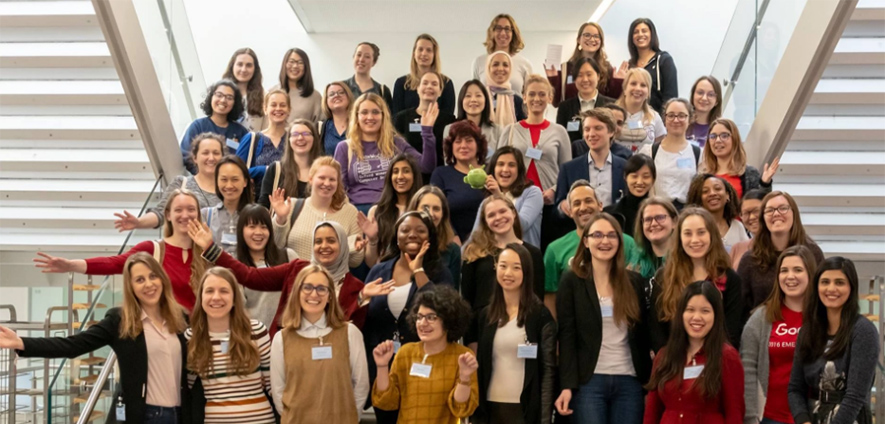
PhD student Mahwish Arif (pictured front right at the Oxbridge Women in Science Conference) arrived here following a stint with the Pakistan Space Agency, a Commonwealth Scholarship and an MSc at the University of Edinburgh. On International Women's Day on 8 March, she tells us about her journey.
Mahwish - whose research interests include parallel programming, multi/many-core architectures, security, compilers and binary translation - is studying for a PhD to develop a software framework for computer security. She is also a Research Assistant in the Computer Architecture group and runs supervisions for undergraduate modules.
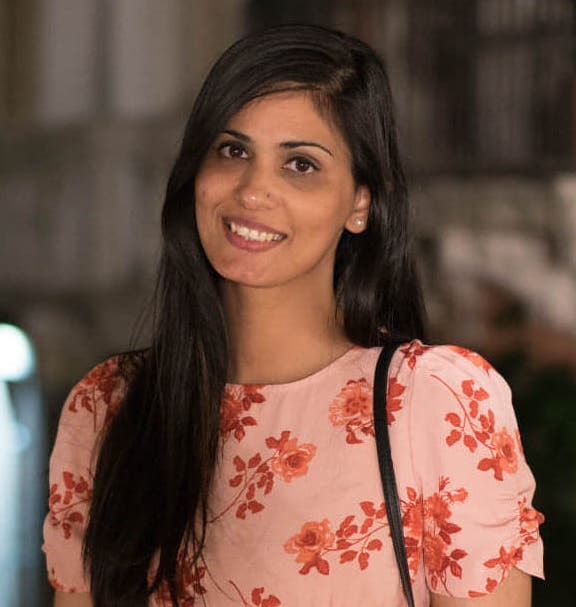 Additionally,
she is the Chair of Women@CL, a network to
support women in computing research in their careers and encourage
them to aspire to leadership positions, both in academia and industry.
Previously Mahwish also held the post of Cambridge Chair for the
Oxbridge Women
in Computer Science Conference. In 2020, her ‘commendable
contribution’ to the work of the Department was recognised through
the Wiseman
Prize.
She will be talking about her work on International Women's Day, Monday 8 March, at an event organised by her college Hughes Hall to celebrate the work of women in STEM subjects.
How did you get into computing and end up studying Computer Science in Cambridge?
I did my undergraduate degree in Pakistan studying Electrical and Electronics Engineering. I then joined Pakistan Space and Upper Atmosphere Research Commission (which is the national space agency) as an embedded systems engineer and worked on both the hardware and software of the system. I enjoyed working more on the software side of the things and wanted to explore that area further. I was awarded a Commonwealth Scholarship funded by the UK government to study for a Masters' Degree in Computer Science. One of my choices was an MPhil at Cambridge but I was rejected at that time and went to the University of Edinburgh instead.
"Ignore all the stereotypical images of “boring” computer science geeks. It's a lot of fun - and really satisfying when you see in working even the smallest piece of code that you have developed."
After my MSc, I worked at Queen’s University Belfast (QUB) as a Researcher in High Performance and Distributed Computing. I was then offered a Research Assistantship at the University of Cambridge in the Computer Architecture group and later started my PhD studies in October last year. My journey to officially starting a PhD was hindered many times due to Home Office administrative hiccups despite being accepted for a fully-funded PhD at three different universities in the UK!
Tell us a bit about your academic passions
For my PhD, I will be working on a software framework for computer
security. As computers have become ubiquitous in our everyday life,
the attack surface has also increased and as a result their security
has become more important than ever. My PhD research will focus on
analysing existing and emerging security threats and develop a
software framework that allows security developers to quickly and
efficiently develop security solutions against different
attacks.
I have also worked on different projects in a range of research areas including compilers, parallel, high-performance and energy-efficient computing, runtime systems and scalable analytics.
Other than doing research, I love to teach. I worked as a part-time teaching fellow at QUB and have been running supervisions for multiple undergraduate modules here at Cambridge as well.
How do you feel being a woman, and a woman of colour, has
helped or hindered your academic career?
Being a woman and coming from South Asian background, I did not have
as many opportunities in life as many people in this part of the
world. This meant that I had to work a lot harder and make use of any
opportunity that came my way. I feel that the attitude towards women
pursuing their careers is slowly changing in a positive way, though we
still have a long way to go to overcome cultural and social
challenges. I feel lucky to have been supported and encouraged by my
family and many of my colleagues.
What inspired you to get involved as Chair of
Women@CL?
I have been positively influenced and encouraged by one of my mentors
and it made me realise the importance of having good mentors and a
support network. I first got involved with Women@CL to organise the
annual Oxbridge Women in Computer Science Conference which we hold
jointly with the University of Oxford. It was a very positive
experience, so I continued to be part of Women@CL. I am now the Chair
of Women@CL for the second year in a row.
How has the pandemic affected your work?
To carry out my research and other duties, I mostly just need my
laptop and can access any special equipment (servers etc) remotely, so
the technical nature of the work has not been affected as such.
However, the pace of work had been affected as we all were getting
used to the new normal of working from home. It has been challenging
to get the right balance between when to stop working and start
relaxing. Most of all, I miss being in the University buildings and
having chats with friends and colleagues over tea and lunches!
Congratulations on winning the Wiseman Prize last
year.
Although I have been involved with Women@CL for almost 2 years, I was
not aware of Wiseman Prize until very recently. I was pleasantly
surprised and honoured to get recognised in this manner. Initiatives
like this boost your motivation and confidence.
What advice would you offer to female students getting into
computer science?
Computer science is one of the very few fields where you can be both
creative and innovative and make big impact even from your couch.
Ignore all the stereotypical images you may have seen about the
“boring” computer science geeks. It is a lot of fun and really
satisfying when you see in working even the smallest piece of code
that you have developed. And don’t be intimidated if you have never
done any coding before (a lot of your peers at Cambridge and elsewhere
have not either).
And, finally, what would be your dream legacy?
To make some contribution through science and education to improve the
lives of most underprivileged sections of the society.
- This story first appeared on the Hughes Hall website and we are grateful to the college for allowing us to reproduce it here.