
A Blue Plaque for EDSAC – Cambridge University’s pioneering first computer
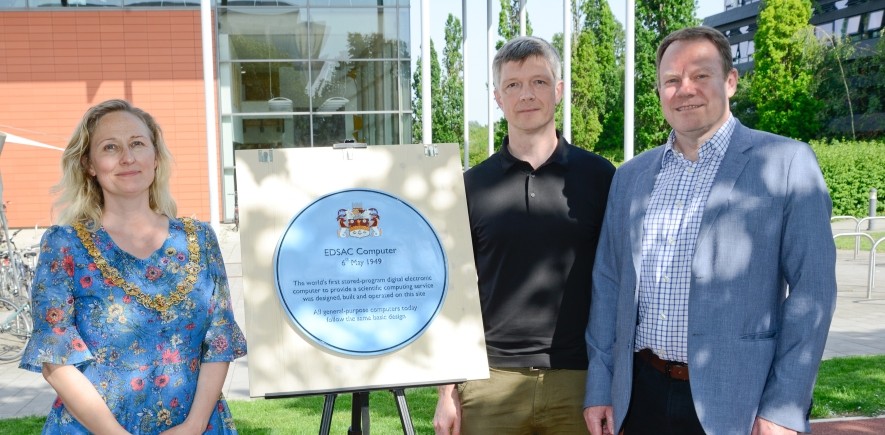
A blue plaque was unveiled in this Department today, 23 June 2026,
to commemorate the development of EDSAC, a landmark event in the
history of modern computing. (See a video of the full unveiling
ceremony here.) 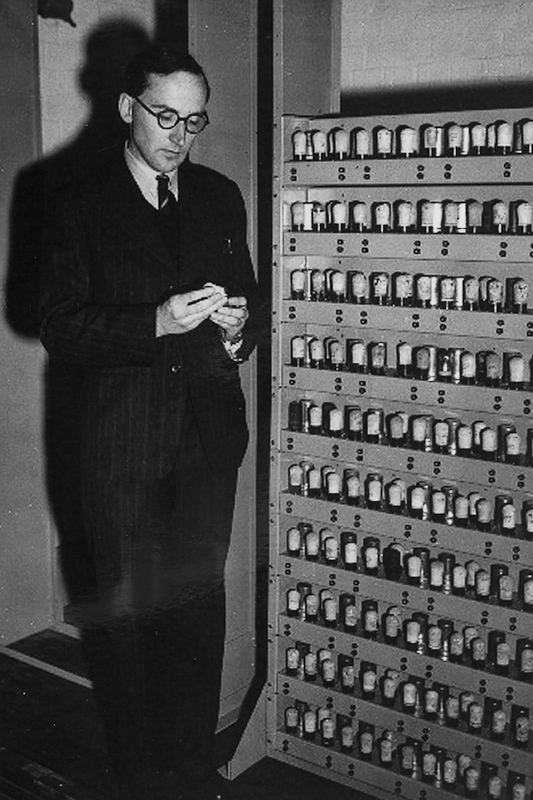
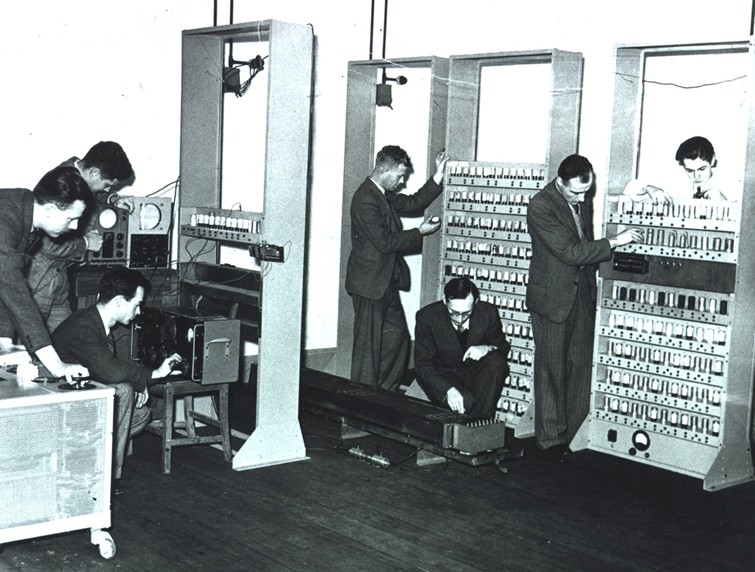
EDSAC - or Electronic Delay Storage Automatic Calculator - was the first electronic computer to go into general use that did not need to be rewired by hand for every new task. Its development marked the birth of everyday computing.
EDSAC weighed two tons and took up a whole room at what was then Cambridge University’s Mathematical Laboratory (nowadays the Department of Computer Science and Technology). When it came into operation, in May 1949, it was the first practical machine of its kind: a general purpose digital electronic 'stored-program' computer that could hold both instructions and data in the same memory.
New fields of science... and Nobel Prizes
EDSAC was truly groundbreaking: it enabled researchers to do work that had previously been impossible and in so doing, opened up new fields of science. It contributed to three Nobel Prizes in the 1960s and 1970s (for Chemistry, Physiology or Medicine, and Physics, respectively). And its immediate successor, EDSAC 2, was used by Francis Crick and James Watson as they continued their research into DNA, following their discovery of its structure using crystallographer Rosalind Franklin's experimental evidence.
Though not the first computer built in the UK (Manchester University’s experimental 'Manchester Baby' preceded it by 11 months), it was the first fully functional computer to be used practically. And as it was thousands of times faster than the mechanical calculators of the period, EDSAC was immediately put to use to help scientists across the University carry out complex calculations. Real-world problems that had previously been impractical to attempt could now be solved.
"Every day, billions of people benefit from technologies whose origins can be traced to pioneering computing work carried out in Cambridge."
Mike Hakata, Cambridge Past, Present and Future
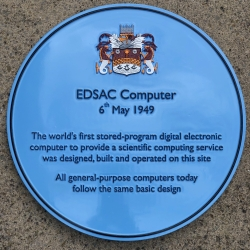
The Blue Plaque to commemorate EDSAC has been created by Cambridge Past, Present and Future. Their Cambridge & District Blue Plaques mark the people and events that have shaped the city and surrounding villages, making history visible in the streets where it happened.
"I'm absolutely delighted that we're commemorating the EDSAC with a Blue Plaque,” said Professor Alastair Beresford, Head of this Department. "Both the machine and the science it enabled were truly groundbreaking. The legacy of this work can be seen across the Department today, where our staff and students continue to deliver world-class research, actively collaborate with industry, and launch world-changing companies."
Pioneering computer science in Cambridge
Mike Hakata, Chief Executive of Cambridge Past, Present and Future, said: "Every day, billions of people benefit from technologies whose origins can be traced to pioneering computing work carried out in Cambridge. The EDSAC represents a turning point in that story, when computing moved from theory into practical reality. Through our Blue Plaques programme, we aim to connect people with the places, people and ideas that have shaped Cambridge and changed the world. We are delighted to recognise this extraordinary achievement and ensure its story remains visible for future generations."
 EDSAC's
creation was led by legendary computer science pioneer Maurice Wilkes
(seen above right with EDSAC, during its construction). His work on
radar technology during the Second World War gave him the idea for how
to create EDSAC's memory. He also benefited from a visit to the USA in
1946 to learn about their world-leading work in computer engineering.
The ideas he brought back to Cambridge helped him and his team develop
EDSAC and get it into operation in May 1949.
EDSAC's
creation was led by legendary computer science pioneer Maurice Wilkes
(seen above right with EDSAC, during its construction). His work on
radar technology during the Second World War gave him the idea for how
to create EDSAC's memory. He also benefited from a visit to the USA in
1946 to learn about their world-leading work in computer engineering.
The ideas he brought back to Cambridge helped him and his team develop
EDSAC and get it into operation in May 1949.
EDSAC could execute approximately 650 instructions per second. While modern computers operate millions of times faster, in the late 1940s and 1950s EDSAC offered a massive improvement on what was possible at the time. The first computer ever built at the University, it is said to have increased productivity 1,500-fold, transforming scientific research.
By the standards of today, it was immensely cumbersome to use: researchers had to translate their instructions into a program punched onto paper tape, which was then fed by hand into the machine. And the queue of programs waiting to be run on the computer was no more sophisticated than a washing line, with a series of hooks and clips to hold the tapes.
Nonetheless, EDSAC was game changing. Ideas about computing that were developed then – such as subroutines – still belong in the basic stock of computing knowledge today. Cambridge computer scientists also contributed to the early development of computer programming languages and operating systems.
 The first
in a series of groundbreaking computers
The first
in a series of groundbreaking computers
EDSAC was the first in a whole line of computers created over the years at Cambridge University. Other notable contributions by the Department include working with Acorn on the BBC microcomputer in the 1980s, which, along with an accompanying BBC programme, encouraged huge growth in computing as a hobby. And in the early 21st Century, staff and alumni helped to establish a charity to produce the Raspberry Pi, the best-selling and most successful UK computer of all time.
Today, Cambridge University’s Department of Computer Science and Technology remains a world leader in its field, conducting pioneering research across many areas of computer science, including computer architecture.
The EDSAC Blue Plaque will be unveiled today at a special ceremony here. Later this summer, it will be installed on the David Attenborough Building, a University building in the centre of Cambridge where the machine was originally built.