
Celebrating a 'culture of innovation' at our Hall of Fame Awards
A semiconductor company distinguished for its rapid growth and the important role it plays in the open hardware movement; a research team turning ordinary earbuds into health sensors; an advance in the field of AI-assisted drug discovery; and a tool used by millions of developers to build, share and run software stacks.
These are the latest winners of our Hall of Fame Awards, which celebrate the 370+ companies started up by current and former members of this Department.
The 2025 awards were presented on Wednesday 15 April during the annual gathering of the Cambridge Ring, our alumni association. At the event, our Head of Department Prof Alastair Beresford discussed the Department's 'culture of innovation' and reflected that "we have always been defined by a willingness to challenge conventional wisdom and our drive to solve practical problems."
He added: "We're immensely proud of our tradition of innovation, but we recognise that it's a living thing, sustained by the people in this room. So thank you and congratulations not only to those of you receiving awards tonight, but all our alumni and friends who continue to contribute to our collective success."
Company of the Year: Rivos
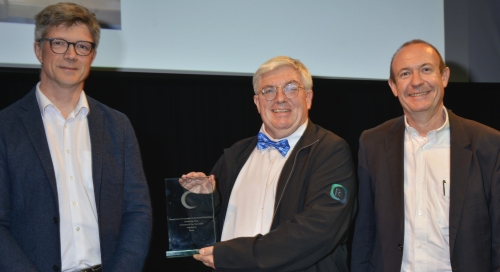 Semiconductor
company Rivos is distinguished for its rapid growth and the
important role it plays in the open hardware movement. Since it was
founded in 2021 by Mark Hayter, Puneet Kumar and Belli Kuttanna, Rivos
has revolutionised high-performance computing by designing GPGPUs and
AI accelerators based on the RISC-V open standard. Their
'software-first' approach to silicon allows for seamless integration
of heavy LLM workloads, a breakthrough that fuelled their rapid global
expansion – including an engineering office in Cambridge. Following a
$250M Series A.3 round in 2024, Rivos' industry-leading expertise
culminated in an acquisition by Meta in late 2025. The award was
collected by Mark Hayter and Tim Ramsdale.
Semiconductor
company Rivos is distinguished for its rapid growth and the
important role it plays in the open hardware movement. Since it was
founded in 2021 by Mark Hayter, Puneet Kumar and Belli Kuttanna, Rivos
has revolutionised high-performance computing by designing GPGPUs and
AI accelerators based on the RISC-V open standard. Their
'software-first' approach to silicon allows for seamless integration
of heavy LLM workloads, a breakthrough that fuelled their rapid global
expansion – including an engineering office in Cambridge. Following a
$250M Series A.3 round in 2024, Rivos' industry-leading expertise
culminated in an acquisition by Meta in late 2025. The award was
collected by Mark Hayter and Tim Ramsdale.
Product of the Year: auryx for auryx
Cambridge-based AI health tech start-up auryx redefines wearable technology by turning everyday earbuds into health monitoring devices. It uses advanced AI algorithms and the built-in microphones in earbuds to monitor wearers' vital signs (heart rate, and breathing rate and volume) with unprecedented accuracy. This enables non-invasive health sensing that doesn't require users to change their daily habits.
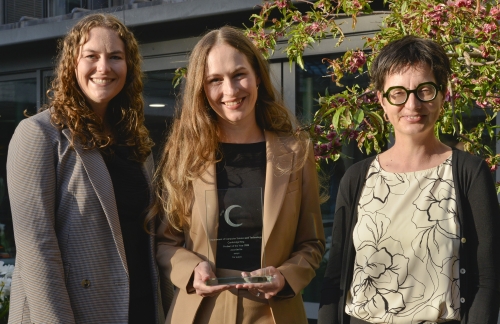 auryx’s core
technologies are derived from high-impact research publications. Its
team (Cecilia Mascolo, the Department’s Professor of Mobile Systems,
and two of her former PhD students, Erika Bondareva and Kayla-Jade
Butkow) have deep expertise in signal processing and machine learning.
This allows the company to deliver robust and reliable physiological
sensing using low-cost, widely-available devices. Unlike other
approaches, auryx offers a software-only solution. The fact that it
doesn't require hardware modification significantly lowers adoption
barriers and enables seamless integration with existing earphone
products.
auryx’s core
technologies are derived from high-impact research publications. Its
team (Cecilia Mascolo, the Department’s Professor of Mobile Systems,
and two of her former PhD students, Erika Bondareva and Kayla-Jade
Butkow) have deep expertise in signal processing and machine learning.
This allows the company to deliver robust and reliable physiological
sensing using low-cost, widely-available devices. Unlike other
approaches, auryx offers a software-only solution. The fact that it
doesn't require hardware modification significantly lowers adoption
barriers and enables seamless integration with existing earphone
products.
Founded in 2025, over the past year the company has successfully raised funding to further refine its algorithms and advance product development and is in active engagement with industry partners. All three of the team came along to collect their award.
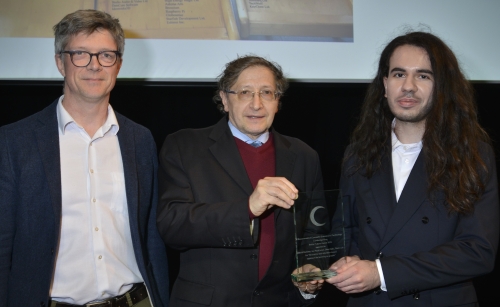 Better
Future Award: David Buterez, Jon Paul Janet, Dino Oglic & Pietro
Lio for: 'An end-to-end attention-based approach for learning on
graphs'.
Better
Future Award: David Buterez, Jon Paul Janet, Dino Oglic & Pietro
Lio for: 'An end-to-end attention-based approach for learning on
graphs'.
Innovative research conducted in collaboration between a graduate student and the global biopharmaceutical leader AstraZeneca has led to an important advance in the field of AI-assisted drug discovery. As published in Nature Communications in 2025, a novel AI approach has been developed that outperforms existing methods to predict the key properties of molecules and identify promising drug candidates.
Graph-based AI models have emerged as promising tools for molecular prediction. In his PhD research, conducted in collaboration with AstraZeneca, student David Buterez (pictured right) developed and trained new graph-based AI models on large, real world drug discovery datasets to see if they could make improved predictions about key properties of molecules, which inform their potential in therapeutic applications. Initial results from the research showed ways that resource-intensive drug discovery processes could be optimised to run more efficiently – and even, David says, to "suggest new active compounds that would likely be missed by traditional drug development techniques".
When he went on to design a new 'Edge Set Attention' model, it set new state-of-the-art results on several molecular benchmarks, outperforming other methods across more than 70 tasks. According to Dino Oglic, Senior Director of Machine Learning & AI at AstraZeneca and a co-author on the paper, "This could accelerate the transition from traditional wet lab work to more sophisticated in silico methods." David Buterez and Prof Pietro Liò collected the award.
Publication of the Year: Anil Madhavapeddy, David J Scott, Patrick Ferris, Ryan T Gibb, Thomas Gazagnaire for: 'Functional Networking for Millions of Docker Desktops'
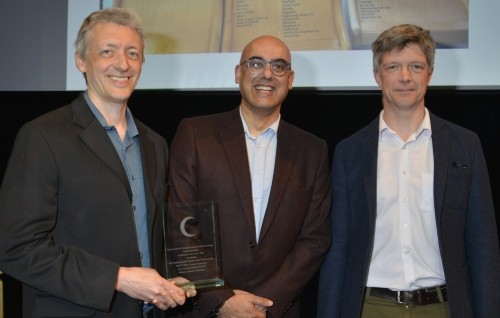 Docker is a
developer tool used by millions of developers to build, share and run
software stacks. The Docker Desktop clients for Mac and Windows have
long used a novel combination of virtualisation and OCaml unikernels
to seamlessly run Linux containers on these non-Linux hosts. This
paper reflected on a decade of shipping this functional OCaml code
into production across hundreds of millions of developer desktops, and
discussed the lessons learnt from the researchers' experiences in
integrating OCaml deeply into the container architecture that now
drives much of the global cloud. It concluded by observing just how
good a fit for systems programming the unikernel approach has been,
particularly when combined with the OCaml module and type system.
David J Scott and Prof Anil Madhavapeddy collected the award.
Docker is a
developer tool used by millions of developers to build, share and run
software stacks. The Docker Desktop clients for Mac and Windows have
long used a novel combination of virtualisation and OCaml unikernels
to seamlessly run Linux containers on these non-Linux hosts. This
paper reflected on a decade of shipping this functional OCaml code
into production across hundreds of millions of developer desktops, and
discussed the lessons learnt from the researchers' experiences in
integrating OCaml deeply into the container architecture that now
drives much of the global cloud. It concluded by observing just how
good a fit for systems programming the unikernel approach has been,
particularly when combined with the OCaml module and type system.
David J Scott and Prof Anil Madhavapeddy collected the award.
There were also three runners-up for the Publication of the Year Award:
- Joseph Gentle & Martin Kleppmann for: Collaborative Text Editing with Eg-walker: Better, Faster, Smaller
- Andrew Slattery & Jonathan Sterling for: Hofmann–Streicher lifting of fibred categories
- and Anh V Vu, Ben Collier, Daniel R Thomas, John Kristoff, Richard Clayton & Alice Hutchings for: Assessing the Aftermath: the effects of a global takedown against DDoS-for-hire services