
Extending robot minds through collective learning
 Intelligent
beings such as humans do not learn in isolation. So neither should
robots, argues Amanda Prorok, Professor of
Collective Intelligence and Robotics, in an editorial on collective
learning in Science
Robotics that she hopes will provoke debate among the robotics
community.
Intelligent
beings such as humans do not learn in isolation. So neither should
robots, argues Amanda Prorok, Professor of
Collective Intelligence and Robotics, in an editorial on collective
learning in Science
Robotics that she hopes will provoke debate among the robotics
community.
At the moment, she says, artificially intelligent agents (whether embodied or virtual) are generally not designed from the beginning to interact with other intelligent agents, be they machines or humans. Yet this approach, which focuses on individual robots operating independently, is not well-suited for the complexities of real-world environments where interaction and collaboration are essential.
"Collective behaviors among robots are often treated as incidental rather than intrinsic to intelligence," she writes, in her opinion article Extending robot minds through collective learning. "Current understanding and foundational AI textbooks still frame the canonical AI problem as that of a solitary machine confronting a non-social environment. Similarly, the classical definition of robot autonomy positions an autonomous robot as one designed to engage with its environment independently, free of any dependencies.
"Although research domains such as multi-agent systems and swarm intelligence have existed for over two decades, groups of autonomous agents still tend to be modeled and dealt with as a self-contained problem that is not core to solving autonomy as a whole."
And that, according to Prof Prorok, is a significant issue. "While current state-of-the-art robot controllers rely on large, monolithic, centrally controlled models with millions or even billions of parameters, scaling laws demonstrate that achieving more sophisticated behaviors requires disproportionately high investments, making this approach to robot autonomy neither scalable nor sustainable – and ultimately, fundamentally misguided."
Swarm intelligence
Prof Prorok has long been fascinated by collective learning and the
idea of swarm intelligence. This concept, when she encountered it at
university, was a life-changing moment for her. "It really resonated
with me," she says. "I knew if there was one idea I’d want to work on
for the rest of my life, this was it."
Today, 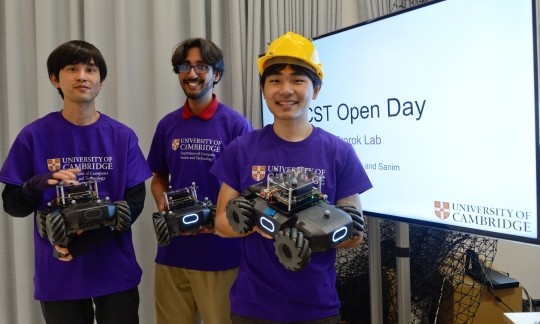 research
in her lab focuses on multi-agent and multi-robot
systems. Their mission is to find new ways of coordinating
artificially intelligent agents (e.g. robots, vehicles, machines) to
achieve common goals in shared physical and virtual spaces. Together
with her lab, Amanda Prorok has pioneered methods for differentiable
communication between learning agents. Their research has numerous
applications, including in automated transport and logistics,
environmental monitoring, surveillance, and search.
research
in her lab focuses on multi-agent and multi-robot
systems. Their mission is to find new ways of coordinating
artificially intelligent agents (e.g. robots, vehicles, machines) to
achieve common goals in shared physical and virtual spaces. Together
with her lab, Amanda Prorok has pioneered methods for differentiable
communication between learning agents. Their research has numerous
applications, including in automated transport and logistics,
environmental monitoring, surveillance, and search.
So it is not surprising that she sees a number of problems with the current status quo. "Today, the typical AI product consists of a monolithic, centrally controlled model," she says, "requiring large amounts of memory, even for inference. Loading large models can require hundreds of gigabytes of working memory, excluding any additional memory needed to store data. At present, such models need to be run off-board and at low inference speeds due to forward pass latency. This precludes their use in high-frequency control, and thus excludes many robotic applications."
'Intelligence is not a single super-organism'
Furthermore, she adds, robotics research "has followed the trend of
integrating off-the-shelf, centralized and monolithic AI models
into autonomy pipelines (with the creation of large, open datasets
further spurring this approach). This decision-making design is
fuelling a push to build 'generalist robots'." But intelligence
is not a single super-organism, she says, nor is it the case that all
conceivable tasks can be accomplished by a single super-robot.
So, "instead of targeting independent robots that can do it all and that are run by the same general 'brain', we should focus on designing collectives of interdependent, diverse, and specialized robots — both in mind and body — that function as part of larger systems. A collective robotic intelligence would, hence, entail a more modular and compositional approach to both hardware and software design, in which multiple models can learn and interact within and across physical robot embodiments. These models wouldn't just be simply combined; instead, they would not only learn individual skills, but would also learn to interact and 'collaborate' with other components and skills from the outset, leading to a more defined understanding of individual and collective capabilities."
The benefits of collective robotic
intelligence
There are several benefits, she thinks, to collective robotic
intelligence, not least cost. "Scaling laws from deep learning
theory reveal that model size and data requirements scale
exponentially in relation to model performance. In other words,
our investments in training—whether in energy, data, or time—must
increase disproportionately as we aim for more sophisticated and
general behaviors."
Furthermore, "there are skills that can only be acquired through social learning in collectives. Building upon the idea of training interaction from the ground up, a collaborative learning process also allows individual specialist models to develop a better intrinsic understanding of their own capabilities and limitations. This awareness naturally fosters an understanding of when and where teaming up with other models becomes necessary to overcome individual shortcomings and achieve more complex goals."
Robotics research, she concludes, is navigating a delicate balance between the transformative potential of machine learning and the unique complexities inherent to robotics. "Although harnessing advances in AI is undoubtedly crucial, real progress requires resisting the allure of short-term gains that sidestep deeper foundational challenges. In particular, we must avoid relying exclusively on large, monolithic models that circumvent systems issues rather than addressing them directly. Instead, collaborative and collective intelligence should form the cornerstone of robotics research — not only because these approaches offer scalable and sustainable solutions, but also because the inherently interactive, distributed, and collective nature of real-world problems demands it."
- Extending robot minds through collective learning, Science Robotics, 24 September 2025.