
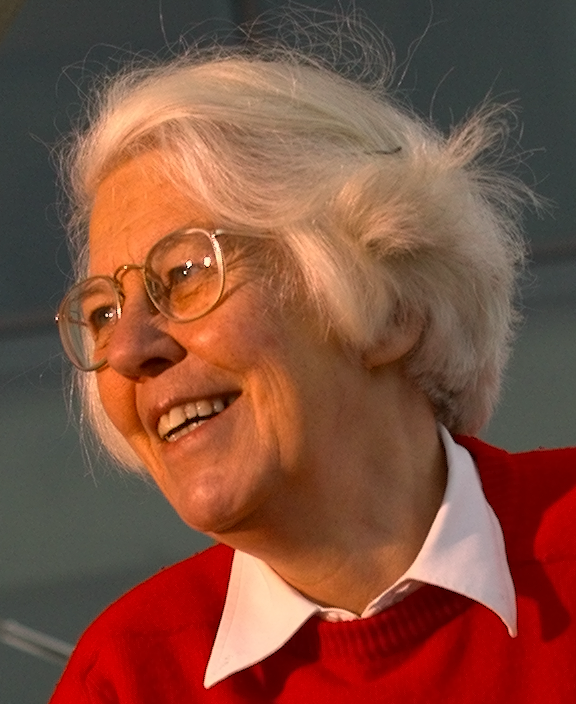
Karen Spärck Jones, FBA
Professor Emerita of Computers and Information
Honorary Fellow of Wolfson College
26 August 1935 – 4 April 2007
Professor Karen Spärck Jones was one of the pioneers in information retrieval (IR) and natural language processing (NLP). She worked in these areas since the late 1950s and made major contributions to the understanding of information systems. Her international status as a researcher was recognised by the most prestigious awards in her field, the ACM SIGIR Salton Award, the American Society for Information Science and Technologys Award of Merit, the Association for Computational Linguistics Lifetime Achievement Award, the BCS Lovelace Medal, and the ACM-AAAI Allen Newell Award, as well as by her election as a Fellow of the British Academy, of the American Association for Artificial Intelligence, and as a European AI Fellow.
Karen Spärck Jones started her research career at the Cambridge Language Research Unit in the late 1950s, working on the use of thesauri for language processing. At this time she collaborated with Roger Needham, whom she married in 1958. Her PhD thesis “Synonymy and Semantic Classification” is now recognised as having been far ahead of its time in its exploration of combined statistical and symbolic techniques in NLP.
In the 1960s, she started working on IR. She introduced IDF term weighting, a technique which has been adopted as standard in modern systems, including Web search engines, and has percolated to other language processing applications. She subsequently collaborated with Stephen Robertson to establish the value of relevance weighting for terms, a key step in the development of a highly successful probabilistic model of retrieval to which she continued to contribute. Later she moved back to research on NLP, although maintaining an interest in IR. She was instrumental in establishing the Intelligent Knowledge Based Systems research area in the UK Alvey programme, which funded hundreds of projects and provided a huge boost to AI and language work in the UK in the 1980s. She also carried out her own research on natural language front ends to databases and on heterogeneous information-inquiry systems.
Her more recent work was on document retrieval, including speech applications, database query, user and agent modelling, summarising, and information and language system evaluation. She received funding for projects on Automatic Summarising, Belief Revision for Information Retrieval, Video Mail Retrieval, and Multimedia Document Retrieval, the last two in collaboration with the Engineering Department. She was a member of the DARPA/NIST Text Retrieval Conferences (TREC) Programme Committee since 1994, and involved with other US evaluation programmes, notably the Document Understanding Conferences on automatic summarising. She was a major figure in the evaluation community and was thus involved in setting the standards for a large proportion of the work in NLP in the US and elsewhere.
Apart from her personal work, Karen Spärck Jones consistently promoted research in her field, both nationally, as in her Alvey Coordinator role, and internationally, perhaps most notably as President of the Association for Computational Linguistics (ACL) in 1994. Her standing as a senior woman in computing was marked by her speaking at the first Grace Hopper Conference, and by giving the Grace Hopper Lecture at the University of Pennsylvania.
In Cambridge, she was involved in teaching on the MPhil in Computer Speech and Language Processing for many years and also taught information retrieval for the Computer Science Tripos. She had many PhD students, working in remarkably diverse areas of NLP and IR.
Karen Spärck Jones had a wide range of outside interests, most notably sailing: she and Roger Needham bought their first boat in 1961 and later sailed an 1872-vintage Itchen Ferry Cutter. Her colleagues at the Computer Laboratory will also remember her very energetic and outspoken nature, her tireless support of the department, and her light-hearted humour and generosity, all attributes that not even her final battle with cancer could affect. She will be sadly missed.
- University of Cambridge obituary
- Leave your comments of remembrance
- Press obituaries: The Telegraph, The New York Times
- CV and selected publications
- Home page with detailed publications list
- “Some points in a time”. Acceptance speech for ACL Lifetime Achievement Award, summarising her research in NLP and IR, Computational Linguistics, 31, 2005, pp 1-14.
- “Natural language and the information layer”. ACM/BCS award lecture video, March 2007.
- Mark Maybury: Karen Spärck Jones and Summarization. In: Charting a New Course: Natural Language Processing and Information Retrieval – Essays in Honour of Karen Spärck Jones. John I. Tait (Editor). Springer, 2005.