
The Wheeler Lectures — our annual distinguished lectures — are named after David Wheeler, one of the early pioneers of Computer Science.
David worked on the original EDSAC computer and wrote one of the first computer programs to be stored in a computer’s working memory. He pioneered the use of sub-routines and is particularly remembered for his work on data compression.
David was elected a Fellow of the Royal Society in 1981, one of the earliest computer scientists to be so honoured. In October 2003, he was made a Fellow of the Computer History Museum for his invention of the closed subroutine, his architectural contributions to the ILLIAC, the Cambridge Ring, and computer testing.
In the late 1940s, David started his PhD in what was then known as the University of Cambridge Mathematical Laboratory (and subsequently became first the Computer Laboratory and then the Department of Computer Science and Technology.) After graduating in 1951, he then spent time at the University of Illinois before returning to the UK. He continued to work in the Computer Laboratory right up until his death, a decade after he had officially retired.
For further information about the Wheeler Lectures, please contact Ben Karniely
2023 — Dr Simon Peyton Jones FRS: Beyond functional programming: a taste of Verse
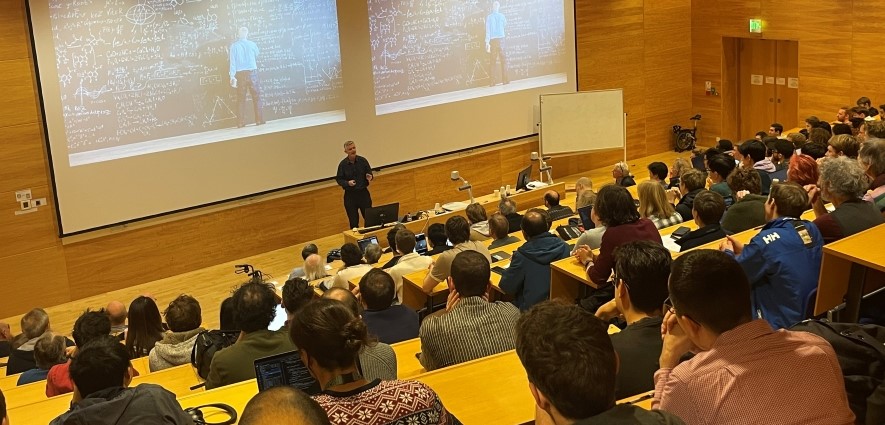
The 11th Wheeler Lecture (pictured above) was given in November 2023 by Simon Peyton Jones, Engineering Fellow at Epic Games and Honorary Distinguished Fellow of this Department.
Abstract: "Verse is a functional logic language with a bunch of innovative ideas. Like Haskell, Verse is declarative (a variable in Verse stands for just one, immutable value) and higher order (lambdas are first class). But Verse goes well beyond Haskell, with existential variables, unification, expressions that yield multiple values, and much more besides. In this talk, I will give a sense of what functional logic programming is about, what it looks like to program in Verse, and how we can give meaning to Verse programs using rewrite rules."
You can watch 'Beyond functional programming' on our YouTube channel.
2022 — Research Showcase replaces Wheeler Lecture
When illness prevented the planned 2022 Wheeler Lecture from going ahead, it was replaced instead with a Departmental Research Showcase, featuring research here on a variety of topics.
2021 — Prof Daniela Rus: Reimagining Robots
The tenth Wheeler Lecture was given by Prof Daniela Rus, Director of the Computer Science and Artificial Intelligence Laboratory (CSAIL) at MIT, in May 2021. Due to covid restrictions, it was delivered virtually.
Abstract: "The digitisation of practically everything coupled with advances in machine learning, the automation of knowledge work, and advanced robotics promises a future with democratised use of machines and wide-spread use of AI, robots and customization. While the last 60 years have defined the field of industrial robots, and empowered hard bodied robots to execute complex assembly tasks in constrained industrial settings, the next 60 years could be ushering in our time with pervasive robots that come in a diversity of forms and materials, helping people with physical and cognitive tasks. However, the pervasive use of machines remains a hard problem.
"How can we accelerate the creation of machines customized to specific tasks? Where are the gaps that we need to address in order to advance the bodies and brains of machines? How can we develop scalable and trustworthy reasoning engines? In this talk I will discuss recent developments in machine learning and robotics, focusing on about how computation can play a role in: developing Neural Circuit Policies, an efficient approach to more interpretable machine learning engines; making machines more capable of reasoning in the world; making custom robots; and making more intuitive interfaces between robots and people."
You can watch 'Reimagining Robots' on our YouTube channel.
2020 — Dr Sophie Wilson FRS: The Future of Microprocessors
The ninth Wheeler Lecture was given virtually in May 2020. It looked at the history of microprocessors, how we got to where we are now, and what constraints there are on the future. There were laws, graphs... and references to Star Wars!
Sophie, an alumna of the department, co-designed (with her colleague Steve Furber) the BBC Microcomputer, BBC BASIC and the Acorn Assembler. They then went on to design the ARM processor, which originally powered Acorn's computers, and is now the core of virtually every mobile phone and tablet in the world.
Sophie is a Broadcom Fellow and Distinguished Engineer, a Fellow of the Royal Society, the Royal Academy of Engineering, the British Computer Society and the Women’s Engineering Society and an honorary Fellow of Selwyn College, Cambridge. She has an honorary doctorate of science from Cambridge University and a CBE.
You can watch 'The Future of Microprocessors' on our YouTube channel.
2019 — Prof Jane Hillston FRS: Combining formal methods and machine learning
The eighth annual Wheeler Lecture took place in May 2019 when Prof Jane Hillston (professor of quantitative modelling and head of the School of Informatics, University of Edinburgh) talked about combining machine learning techniques into a formal modelling framework.
You can watch a recording of her lecture here.
2018 — Prof Stephen Pulman FBA: Language, learning, and creativity
The seventh annual wheeler lecture was given at the Computer Laboratory on Wednesday 30th May, 2018. The speaker was Prof Stephen Pulman, Professor of Computational Linguistics in the University of Oxford, Professorial Fellow of Somerville College Oxford, and a Fellow of the British Academy. His lecture focused on the linguistic aspects of the Turing test, the creative aspect of language use, and the implications for machine learning.
Stephen Pulman's abstract and lecture can be viewed here.
2017 — Prof M. Angela Sasse FREng: Can we make people value IT security?
In the sixth Wheeler Lecture, Prof M. Angela Sasse, focused on some of the usability considerations in designing security mechanisms. Professor Sasse is Professor of Human-Centred Technology in the Department of Computer Science at University College London and Horst Görtz Endowed Professor of Human-Centred Security at Ruhr University Bochum. She was named a Fellow of the Royal Academy of Engineering in 2015 for 'demonstrating the impact of human security behaviour, and developing a socio-technical approach for modelling and managing that behaviour effectively'. Her abstract and a recording of her talk can be seen here.
2016 — Dr Andrew Herbert FREng: A History of Virtualisation in Operating Systems.
In the fifth Wheeler Lecture, Dr Andrew Herbert, gave an overview of virtualisation techniques in operating systems. Andrew obtained his PhD in this Department and, after working here with Roger Needham and Maurice Wilkes on the 'Cambridge Model Distributed System', founded his own research company and subsequently went on to become Managing Director of Microsoft Research Cambridge. He is a Fellow of the Royal Academy of Engineering and was made an OBE in 2010. Andrew is chairman of trustees for the National Museum of Computing at Bletchley Park and led a project to reconstruct a model there of the EDSAC Computer. You can see his abstract and a recording of his talk here.
2015 — Prof Butler Lampson: Hints and Principles for Computer System Design
The fourth Wheeler Lecture was given in May 2015 by Butler Lampson, Technical Fellow at Microsoft. and Adjunct Professor at the Massachusetts Institute of Technology. AYou can see his abstract and a recording of the talk here.
2014 — Prof Jeannette M. Wing: Computational Thinking
The Computer Laboratory celebrated the 10th Anniversary of women@CL on Wednesday 14th May 2014, and the annual Wheeler Lecture was given on that day by Jeannette M Wing, Executive Vice President for Research and Professor of Computer Science at Columbia University and formerly the Avanessians Director of Columbia's Data Science Institute. Her abstract and recording can be seen here.
2013 — Sir Tony Hoare FRS: Could Computers Understand Their Own Programs?
The second Wheeler Lecture was held on the day the Department (then known as the Computer Laboratory) celebrated its 75th anniversary - 24 April 2013. The speaker was Sir Tony Hoare, Emeritus Professor of Computer Science at the University of Oxford, Principal Researcher at Microsoft Research and Honorary Member of the Cambridge Computer Laboratory. You can see his abstract and watch a recording of his talk here.
2012 — Bjarne Stroustrup: C++11 Style
The first Wheeler Lecture was held at the University of Cambridge Computer Laboratory on Wednesday 15 February 2012, at 16:00. The speaker was Bjarne Stroustrup who talked on C++11 Style. Abstract, recording, and further details.
