
Security Group
Electromagnetic eavesdropping on DisplayPort – dataset and code
This is the page where we plan to make available the Julia implementation and SDR recordings needed to reproduce figures 17–24 of our journal article
Dimitrije Erdeljan, Markus G. Kuhn: Electromagnetic eavesdropping on DisplayPort, IEEE Transactions on Dependable and Secure Computing, Vol. 23, No. 3, pp 5404–5421, May–June 2026. DOI: 10.1109/TDSC.2026.3653840
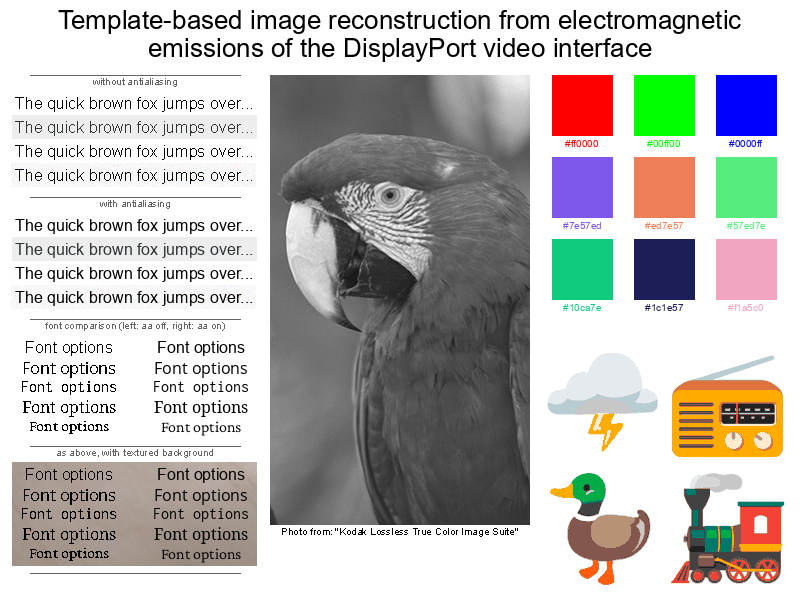
Displayed test image
- testimage.png (800 × 600 pixels, 8-bit/colour RGB)
SDR recordings of DisplayPort emissions
Used for figures 17–23:
- dp-5m-800x600-testimage-1-1.h5 (5 m distance, HDF5 format, ~400 MB)
- dp-8m-800x600-testimage-1-1.h5 (8 m distance, HDF5 format, ~400 MB)
See load.jl for more information on how to load the data.
(We also recorded, about two minutes after the respective above recordings, a noise reference recording: same setup, but the DisplayPort transmitter was off: dp-5m-noise-1.h5, dp-8m-noise-1.h5. These were not used in the paper, but are provided here for readers interested in comparing SNR levels.)
SDR recording of HDMI emissions
Used for figure 24:
- testimage2-800x600-60-320M-64M-40M.dat (320 MHz centre frequency, 64 MHz sampling frequency, 40 MHz flat bandwidth, 640 MB)
This IQ recording file is a sequence of little-endian 32-bit floating-point numbers, alternating real and imaginary components. Load e.g. in Julia with
using Mmap
s = mmap("testimage2-800x600-60-320M-64M-40M.dat", Vector{ComplexF32})
HDMI target: Raspberry Pi Model B Plus Rev 1.2, iiyama XUB2495WSU display, 8 m distance, Schwarzbeck VUSLP 9111B antenna, R&S FSV7 receiver. Same test image as above, video mode 800x600@60Hz DMT.