
Computer Networking
Changes This Year
Although there is a new lecturer this year, the materials will be largely unchanged.
One addition will be a glossary of terms. Candidates should be able to explain all of the words in the glossary and expect them to appear in Tripos questions.
Timetable
An extra slot has been added to the published timetable this year. This is primarily because there will be no lecture on Friday 13th February. It is possible that the slot will be filled with alternative materials, such as an Examples class or Q+A discussion, but currently this is not likely.
Lecture Slides
The lectures are being revised slightly from last year.
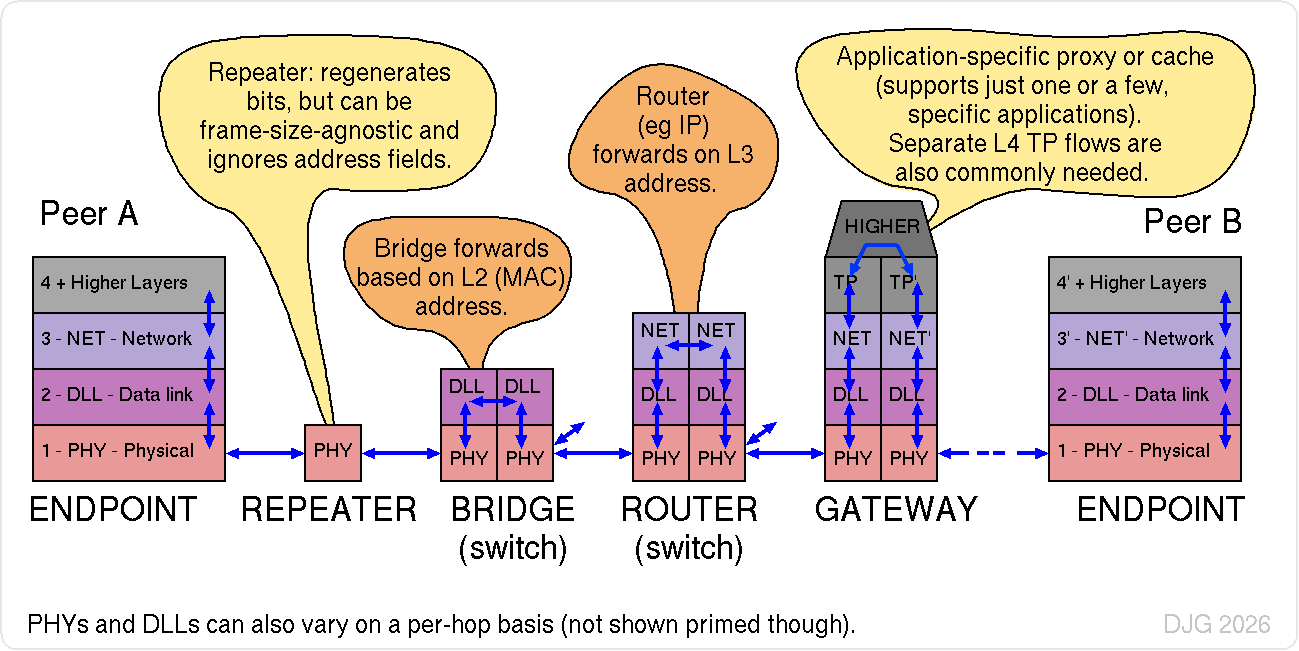
Topic 1 - three lectures - Foundations: Slides (PDF); Notes: (P+D Part 1).
Topic 2 - two lectures (or 2.5) - Architecture and Philosophy: Slides (PDF); Notes: (P+D Part 1 again) and early parts of (P+D 3.3).
Topic 3a - Physical Layer (L1) - Slides PDF. Lecture notes Physical Channels HTML. Book Chapter 2: Direct Links.
Topic 3b - Data link layer and DLL/MAC (L2) - Slides PDF. Book Chapter 2: Direct Links, section 2.3 onwards.
Topic 4 - Network Layer (L3) - Not ready yet.
Topic 5 - Transport Layer (L4) - Not ready yet.
Topic 6 - Applications - Not ready yet.
Note: nearly all of the detail under the Topic 3a heading is not relevant for a Computer Science degree. Instead, it is Computer Engineering. Candidates should understand the basic information capacity formula and the differences between cable and wireless, and the names and differentiating aspects of each of the topics presented, but need not study any of the block diagrams or power budgets presented. The formal syllabus is on the first tab of the course web page; it does not explicitly mention the physical layer (L1). But aspects of the physical layer, especially wireless networks, inevitably affect the data link layer (Topic 3b). Note the ordering of materials has varied since the syllabus was last updated. [Error detection and correction is on the syllabus so has been moved from 3a to 3b for clarity.]
Lecture Notes
For most of this course, it is pointless having local lecture notes when there are great books, but a few further notes and clarifications will likely be posted in this section as we go.
The recommended book is Computer Networks: A Systems Approach, VIth edition Peterson and Davie soft online copy, GIT resources.
Lecture slides can be printed for you by the department on request. Put your name down at Student Admin if you'd like a copy. Last year, very few were wanted. Electronically annotating a PDF may be more convenient? Possibly the best thing to have in hardcopy form is one of the recommended textbooks.
Further notes and clarifications: HERE.
Glossary
Not ready yet; will be started shortly and augmented in sections, as we go.
Last Year's page
Please see last-year's materials for further recommended book(s) and all other materials, including the supervision examples sheets, the Hands-on Materials and further secondary materials.
Secondary Materials
Beyond last-year's materials, a few items will be posted in this section.

In Lecture 2 (switching paradigms) people could inspect this item: Crossbar Circuit Switch that uses the same Strowger uniselectors used in the first generation, british automatic telephone exchanges.
About The Lecturer
The lecturer, David Greaves, has designed various computer networks. In the early 1980's he constructed a LAN at his VIth-form College for PET microcomputers GPIB Combiner; in the early 1990's he designed the first equipment to send data at more than 100 Mbps over the Granta fibre network around the University of Cambridge, and in the later 1990's his team designed the first video-on-demand system in the UK, the Cambridge iTV trial, and then went on to design early ADSL broadband modems, as widely used today.
DJG.