
Introduction to Computer Architecture
Course Handout
The following materials are available for those in the cam.ac.uk domain. Lectures are presented live with recordings available via the Recordings tab.
Laboratories
The ECAD+Arch laboratory sessions are loosely coupled to this lecture course. Please review the laboratory pages since there is a compulsory component.
Supervision Exercises
Supervision exercises are available here: Supervision Questions (PDF). Supervisors can find sample answers on the supervisors tab.
Additional Material
- The RISC-V instruction set reference manual is available from the RISC-V foundation as a PDF
- Excellent YouTube video from the Veretasium channel presenting the challenges of modern lithography: YouTube Video - The Ridiculous Engineering Of The World's Most Important Machine
- The EDSAC Movie on YouTube
Past Exam Questions
Please note that the course used to be called Computer Design, so past exam questions are under that title: Past Exam Questions in Computer Design
Also see the recent questions: Past Exam Questions: Introduction to Computer Architecture
Errata
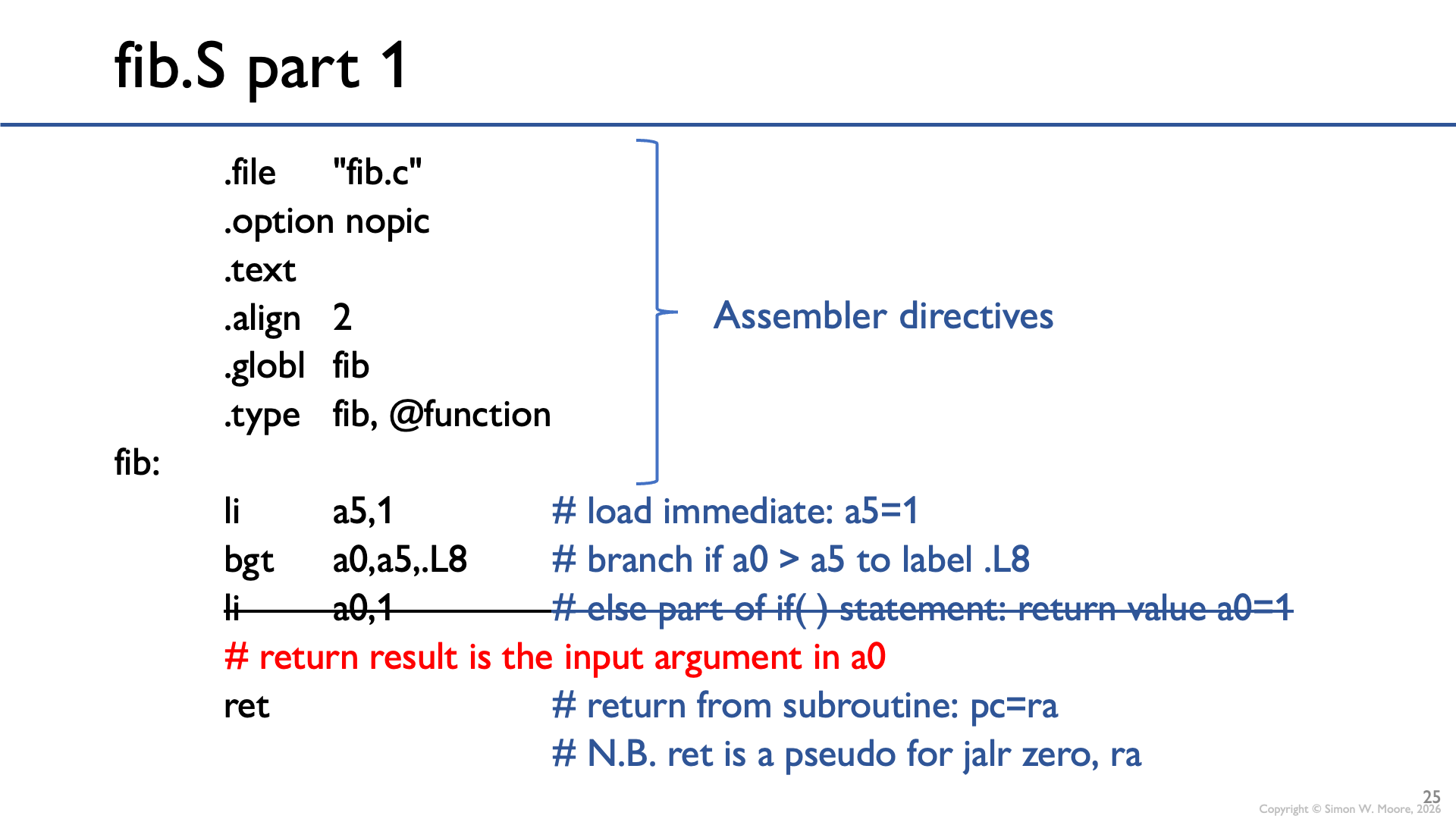
Lecture 5, slide 25 - the assembler version of the fib() function incorrectly returned 1 for fib(0) and fib(1) when it should return the input argument. The corrected assembler is below.
Lecture 13 - The assembler used in these slides is half way between the MIPS and RISC-V ISAs. The key points in the lecture are still correct, but in future the slides will be updated to use RISC-V ISA compliant instructions. In particular, moving to the R-type instruction format for load-reserved and store-conditional instructions. Specifically:
-
The load-reserved instruction appears in the slides as an I-type
instruction to match conventional load instructions. This is
incorrect, load-reserved is an R-type instruction of the
form:
lr.w t0, (a0)wheret0is the destination register anda0is the source address register. There is no immediate address offset. -
The store-conditional instruction appears in the slides as an
S-type instruction to match conventional store
instructions. This is incorrect, store-conditional is an R-type
instruction with a register specified address and no immediate,
just like load-reserved. Moreover, store-conditional has both
source and destination registers vis:
sc.w t0, a2, (a0)wheret0is the destination register indicating if the store-conditional succeeded (1) or not (0);a2is the source register (data to be stored) anda0is the address. There is no immediate offset.