
Members of the Rainbow Graphics & Interaction Group
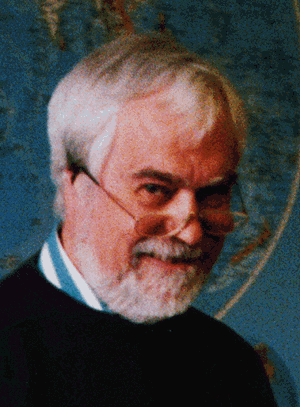
Neil Wiseman
Neil Wiseman, Reader in Computer Graphics at the University of Cambridge Computer Laboratory died of cancer on Tuesday 13 June 1995 at his home in Cambridge, England, after a year’s illness.
Born 19 May 1934, Cowlinge, Suffolk, England; died 13 June 1995, Cambridge, England; Reader in Computer Graphics at the University of Cambridge Computer Laboratory. Contributor for 30 years to computer graphics and its applications, including display architectures, modelling, rendering, interaction techniques, computer-aided design, graphic design and computer animation.
Education: BSc (Engineering), Queen Mary College, University of London, 1957; MS in Electrical Engineering, University of Illinois, 1959; MA, University of Cambridge, 1964; PhD, University of Cambridge, 1970.
Professional experience: Electronic Engineering Apprentice, Pye Ltd, 1950–1953; Graduate Assistant, University of Illinois, 1957–1959; Head of Advanced Circuit Group, Elliott Bros (London) Ltd, 1959–1961; Chief Engineer, Mathematical Laboratory, University of Cambridge, 1961–1970; University Lecturer, Computer Laboratory, University of Cambridge, 1970–1986; Fellow of Wolfson College, Cambridge, 1983–1995. Reader in Computer Graphics, Computer Laboratory, University of Cambridge, 1986–1995.
Appreciation
The following appreciation was delivered by Peter Robinson at Neil Wiseman’s funeral on 26 June 1995:
I only had the privilege of knowing Neil Wiseman for the past 20 years, first as his student and later as a colleague; there are many here whose memories go back much further. We each have our own particular recollections of his academic inventiveness and enthusiasm, his teaching skills, his wisdom and gentle humanity, and especially his sense of humour. Working with Neil was never dull. I would like to share a few cameos from his life with you now.
Neil showed an early technical aptitude and in 1950 he joined the Pye electronics company in Cambridge as an apprentice, which was to prove a regular path for engineers into the University’s Mathematical Laboratory in the 1950s and 1960s. At the time, television was just becoming fashionable after the suspension of transmissions during the second World War. The technological challenge and the supply of war surplus components proved irresistible to an enthusiast like Neil and he built his own television receiver. Indeed, it was a colour set, and the colour was green. This was because the only cathode-ray display tubes that were readily available were war surplus radar tubes. These had the further disadvantage that they had a fairly long-persistence phosphor; once part of the screen had been illuminated it continued to glow for several seconds. This meant that any movement in the picture became seriously blurred. However, it worked.
At home, this enterprise had a further challenge in the absence of mains electricity, which Neil duly solved by installing his own generator. This was not quite as stable as might be desired, so even static pictures became blurred as they drifted across the long-persistence tube. But it was television, and the neighbours in rural Suffolk overcame their natural suspicion of what looked dangerously like witchcraft to gather round and watch the live outside broadcasts of the Queen’s Coronation.
Spurred by this success, Neil enrolled in 1954 to study Engineering at Queen Mary College, London, and duly graduated in 1957. During this time he started working for the Mathematical Laboratory during vacations, notably on the construction of the high speed photo-electric paper tape reader. He also brought with him plans for the long-persistence television and in due course the design was copied and several were built in the laboratory.
Neil’s talent was easily recognised and it was arranged that he should go for two years to the University of Illinois to study for a Masters degree in Electrical Engineering. Work there on the Illiac had much in common with the Cambridge approach and Neil joined a series of distinguished emissaries – Wheeler, Gill, Douglas – who had all spent time there following Maurice Wilkes’ visit in 1950. It was there that he published his first paper, filed his first patent and began to develop a taste for teaching as a graduate assistant.
On his return, there was the problem of National Service. Neil had seen enough of crashed aeroplanes in East Anglia during the war to develop a fervent distaste for all things military. In the event the problem was solved by his working for two years as the Head of the Advanced Circuits Group at Elliott Brothers, investigating new radar technologies. It was at Elliott’s that he started working with tunnel diodes, which showed great promise as a high speed technology.
Then, in 1961, after 10 years of intermittent contact, he finally joined the staff of the Mathematical Laboratory as Chief Engineer. He continued working with tunnel diodes and constructed a prototype store capable of running at 250 megahertz, a speed which would be impressive today and was phenomenal then. Construction with tunnel diodes was a tricky business and wiring such high speed circuits required new techniques. Neil investigated a form of printed wiring on glass substrates – a sort of precursor of integrated circuits – which involved etching with powerful solvents, some of which were brewed specially on the premises. This led to Neil securing for the laboratory a Customs and Excise licence for running a private distillery. I understand that its use was not entirely academic.
However, Neil’s interests were broad – one recent tribute quite properly described him as a renaissance man – and he soon found a new challenge with the arrival of one of the world’s first mini-computers, the DEC PDP-7, and its type 340 vector display. Neil designed a high-speed data-link to connect this to the main Titan computer. This was duly commissioned and probably counts as the world’s first distributed system. In any case, it proved a valuable research tool for work on computer aided design, both for mechanical components and for Neil’s own work on electronic circuits. The Rainbow integrated CAD system combined electronic design, computer graphics, data structures and the control of change in large bodies of data, interests which have continued to challenge Neil’s students in the Rainbow Group ever since. He also began to work on screen editors for text, anticipating the ubiquitous word processor of today, and, later, a television camera was connected to the PDP-7, anticipating multi-media.
By 1970 Neil had published 15 papers and 3 patents, had supervised three students for doctoral dissertations, and was himself approved for a PhD under the special regulations (through submission of published work). He was appointed to a University Lectureship, and was immediately seconded to the Cambridge University Press where he employed his experiences with the PDP-7 display in a project to design and implement a computerised type-setting system.
Returning to the Computer Laboratory in 1973, Neil picked up the threads of the Rainbow work with the new PDP-11 computer and Vector General display, and soon attracted a flock of research students. The Head of Department was even heard to observe that, “Far too many students were opting to work with Wiseman,” but Maurice Wilkes also spoke of Neil as the epitome of the adage that, “If you want to get something done, ask a busy man.” Neil was always busy but he always had time for his students; he was absolutely reliable and dependable, thriving as his acolytes did too.
Neil was prodigiously successful as a research supervisor. At the last count, he had supervised 40 successful students, who now hold a variety of academic posts around the world and in research laboratories here and, particularly, on the West coast of America. He was held in great affection by his students and inspired a curious team spirit in them. His students often took their holidays together, although I think that Carol and I were the only ones to go so far as to marry each other.
The 1970s also saw Neil embark on his collaboration with David Kindersley, a fruitful exploration of the mathematics underlying the aesthetics of lettering. Every Saturday morning would find the two of them hunched over the Vector General display slowly refining algorithms for typeface design and letter spacing. He even set the Tripos examination papers one year using the Laser Scan plotter, which resulted in an aesthetic delight although the production process was something of a security nightmare.
In the 1980s Neil brought one of the first Apple Macintoshes into the Laboratory. Many people regarded this funny little machine with pictures on its screen as a bit of a joke, only useful for games. The fact that this particular model had a faulty keyboard, causing each key to type the letter next to it in the row, meant that it really was a bit of a joke, but Neil saw an exciting new area for research and the Rainbow display project was born, combining his enthusiasms for electronic design and computer graphics.
By this time Neil was running the Diploma course and looking after general graduate admissions into the department. He cared about students and loved teaching. When undergraduate teaching in the Laboratory was extended and the opportunity arose to introduce a hardware laboratory for practical work, Neil duly devised experiments, procured equipment, even negotiated for bench space and the lab was established. It was an immediate success and continues with only minor modifications today.
When a student survey criticised his lecturing he didn’t take umbrage as many might have done, but set to work to organise his notes and improve his presentation. Even this last term, when he was growing weaker, he still insisted on coming in to deliver his beloved lectures on graphics. Only when he was actually kept in hospital would he let me stand in for him. At the end of the course he received a standing ovation and this year’s student survey carries the usual complimentary remarks, only one student added a caveat to the effect that “This refers to the part of the course lectured by Dr Wiseman, not Dr Robinson.”
Other universities tried to tempt him with professorships, but Neil loved Cambridge, the University and the Laboratory, and had no inclination to move. In 1983 he became a Fellow of Wolfson College and in 1986 a personal Readership in Computer Graphics was created for him.
Even his illness this past year could not suppress Neil’s enthusiasm for work. As well as lecturing, he has continued to supervise his students and to contribute to research projects on self-timed logic (actually using ideas from the tunnel diode work of 30 years earlier) and on the autostereo display and its applications in medicine. He endured his illness with great dignity and even humour. When I visited him at home just after he had come out of hospital for the last time, I happened to be wearing this jacket and, although he was weak and in pain, Neil somehow found the energy to tease me about the fact that I was unduly smartly dressed. He was Neil to the end.
When Roger Needham broke the news of Neil’s death to the laboratory, he described Neil as being “of the fabric of the laboratory.” For over 40 years Neil has been focal to much of what has happened in the laboratory. His door was always open, he was always ready to listen and to advise. I have only realised this past fortnight how much I used to look forward to hearing his voice along the corridor so that I could go and chat. But now the door is shut and we have lost his wisdom, his humanity, his friendship. I miss him deeply.
Today we say farewell to all that is mortal of Neil Wiseman, but his spirit lives on. It lives on in over 70 research publications, in 40 PhDs around the world, in hundreds of other graduate students and thousands of people whose lives he touched. We are all the better for having known him. Thank you, Neil.
Bibliography
- F-element, W.J. Poppelbaum and N.E. Wiseman, US Patent Application AEC patent case S-21, 769 Serial 1830, 1960 (assigned to AEC).
- High speed switching circuits, N.E. Wiseman and G.W. Monk, UK Patent Application 46122/63 Reference 17922, 1964 (assigned to Elliotts).
- Systems Design of a Small, Fast Digital Computer, H. Schorr and N.E. Wiseman, IEEE Trans EC, Vol. EC-12, No. 5, December 1963.
- A Scope Text Editor for the PDP7/340, N.E. Wiseman, DECUS Proceedings 1966, European Spring Seminar, pp 9–16.
- A Stored Microprogram Control Unit Using Tunnel Diodes, N.E. Wiseman and P.C. Wright, Radio and Electronic Engineer, Vol. 37, No. 3, March 1969 (awarded Charles Babbage Prize for 1969 by IEE).
- A new method of visual scene input to a digital computer, J.H. Tucker, N.E. Wiseman and N.W.P. Unwin, UK Patent Application 58719/69, 1970 (assigned to NRDC).
- RAINBOW – a multi-purpose CAD system, N.E. Wiseman, C.J. Cheney, M. Etherton, J.O. Hiles and H.U. Lemke, Software – Practice and Experience, Vol. 2, pp 359–375, 1972.
- An Operating System for Interactive Terminals, N.E. Wiseman and P. Robinson, Software – Practice and Experience, Vol. 7, No. 4, pp 507–510, July 1977.
- On making Graphic Arts Quality Output by Computer, N.E. Wiseman, C.I.C. Campbell and J. Harradine, Computer Journal, Vol. 21, No. 1, pp 2–6, February 1978.
- Non-serial language, N.E. Wiseman and C.A. Linden, in Processing of Visible Language 1, P.A. Kolers, M. Wrolstad and H. Bouma (Eds), New York, Plenum Press 1978.
- Letter Spacing, D.G. Kindersley and N.E. Wiseman, British Patent 37544-78, April 1979.
- Aspects of Quality in the Design and Production of Text, A.M. Pringle, P. Robinson and N.E. Wiseman, Proceedings ACM SIGGRAPH-79, Vol. 13, No. 2, pp 63–70, August 1979.
- Computer Designed Letters, N.E. Wiseman, Information Design Journal, Vol. 1, No. 4, pp 218–222, 1980.
- Vectors, Rasters and Cartographic Databases, N.E. Wiseman, Cartographica, Vol. 19, No. 2, Summer 1982, pp 111–119.
- A Soft-edged Character Set and its Derivation, A.J. Wilkes and N.E. Wiseman, Computer Journal, Vol. 25, No. 1, pp 140–147, February 1982.
- Operations on Quadtree Leaves and Related Image Areas, M.A. Oliver and N.E. Wiseman, Computer Journal, Vol. 27, No. 2, pp 112–129, May 1984.
- The RAINBOW Workstation, A.J. Wilkes, D.W. Singer, J.J. Gibbons, T.R. King, P. Robinson and N.E. Wiseman, Computer Journal, Vol. 27, No. 2, pp 112–129, May 1984 (awarded the Wilkes prize for best CJ paper of 1984).
- Encyclopaedia Britannica entry on Computers for 1985 edition, N.E. Wiseman and A.M. Pullen, Summer 1984.
- Skeletal Strokes, S.C. Hsu and N.E. Wiseman, Proceedings UIST conference 1993.
- 3D Colour Display, N.E. Wiseman and A.R.L. Travis, British Patent Application 90/4925/01, 19 Nov 1993.
- Autostereoscopic 3D Display in Laparoscopic Surgery, N.A. Dodgson, N.E. Wiseman, S.R. Lang, D.C. Dunn and A.R.L. Travis, Proceedings of CAR95, Berlin, June 1995.