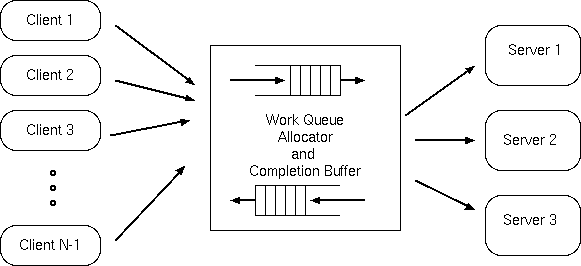
Server Farm Concept.
Q. If you are going to do something lots of times, is it always more efficient to invest heavily in planning to get a rapid execution ?
A1. Following that approach lead Intel to Itanium VLIW processor. But has that has sunk?
A2. Classical HLS has saved a lot of energy based on static schedules. (Have you tried compressing MPEG on your laptop and then wondered how your mobile manages it so easily ?)
The Kiwi CSharp flow uses classical HLS on each thread in turn to generate a static schedule for that thread, but these interact dynamically. E.g. using FIFO queues between components.
Combined with a server farm we get localised static schedules and global dynamics.
A hardware server can be shared (contended for) by multiple clients. For example, Bluespec's rich library contains a Completion Buffer and other flexible structures for easy creation of pools of servers for dynamic load sharing.
Alternatively: current research, (Ali Zaidi) discards input control flow and compiles to locally to dataflow hardware: The VSFG-S Approach. KiwiC should have a plugin for this soon...
| 23: (C) 2012-17, DJ Greaves, University of Cambridge, Computer Laboratory. |