Experiment record v2 · 17 August 2026

Noise-aware Gaussian reconstruction, from stable supervision to stable geometry.

  • Fixed backbone: channel-wise RGB-SVF + 2DGS.
  • Strong under calibrated synthetic RAW noise.
  • Wins on part of Dark3R.
  • Not yet universally better on real scenes.
  • Main remaining failure: geometry.
  • Unreliable observations change support, scale, and densification.
  • Appearance then compensates with large translucent splats.
+2.831 dBRGB-SVF 2DGS vs Vanilla 3DGS · RawNeRF x64
+1.102 dBRGB-SVF 2DGS vs Vanilla 3DGS · Dark3R Chapel 1/500
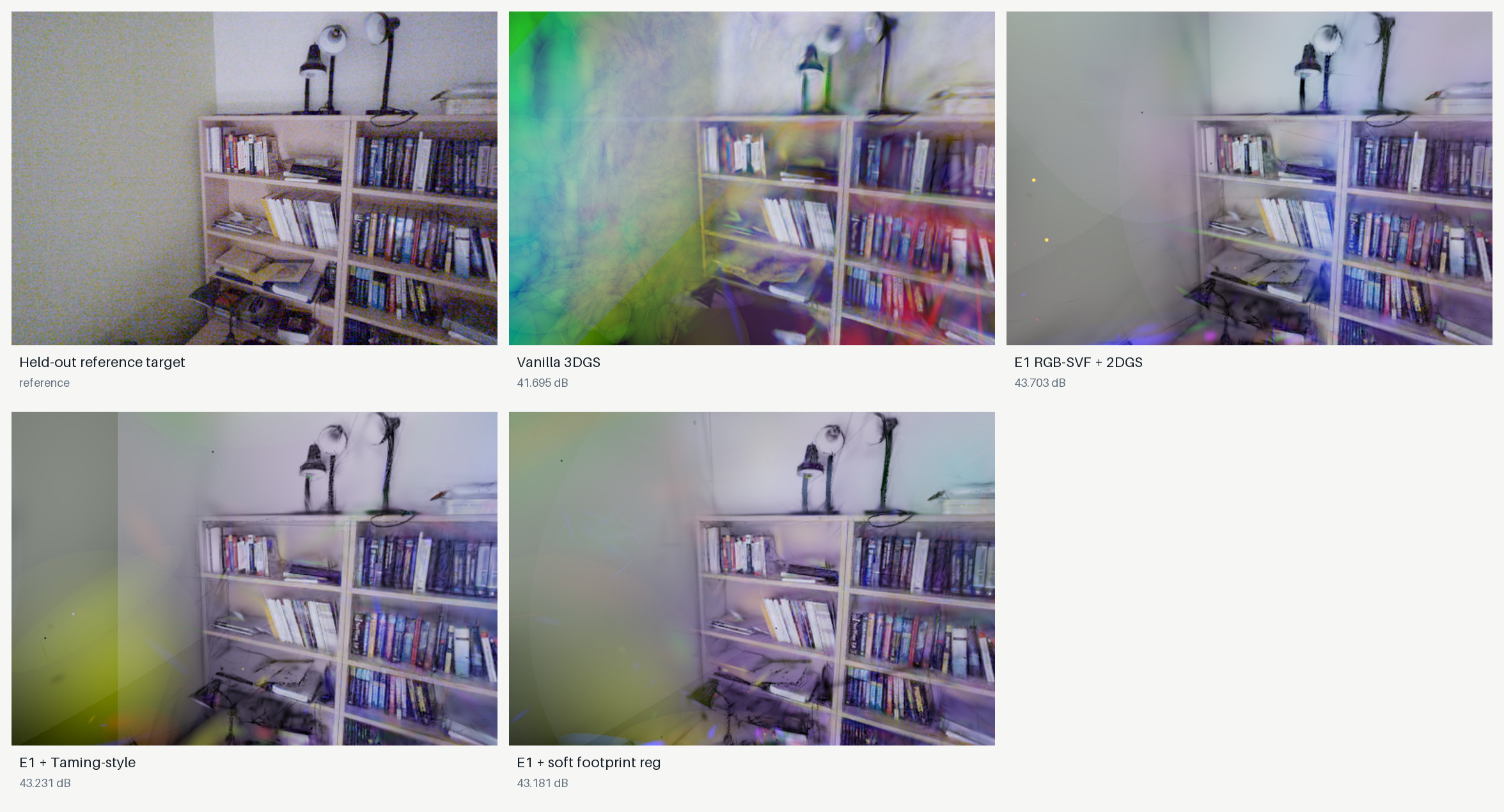
+2.008 dBE1 RGB-SVF 2DGS vs Vanilla 3DGS · Dark3R Bookshelf
mixedCave D3/D5/D6 and Dark3R Statue prevent a universal-win claim
Implemented: RGB-SVF + 2DGSImplemented: NTF-TGCompleted: real geometry/appearance oracleNext: persistent geometry prior
02 · What is actually validated

One method, three domains, three different answers.

  • Use one fixed backbone across datasets.
  • Report texture and geometry modules as separate ablations.
  • Do not rename every successful run as the method.
Controlled evidence

RawNeRF synthetic

  • SVF wins every noisy level.
  • 28.942 dB at x64.
  • NTF-TG reaches 31.561 dB.
  • Current input is still an 8-bit proxy.
Real low light

Dark3R

  • Wins Chapel 1/125–1/500.
  • Wins Bookshelf.
  • Loses Statue and Chapel 1/800.
  • Large splats remain.
Real domain shift

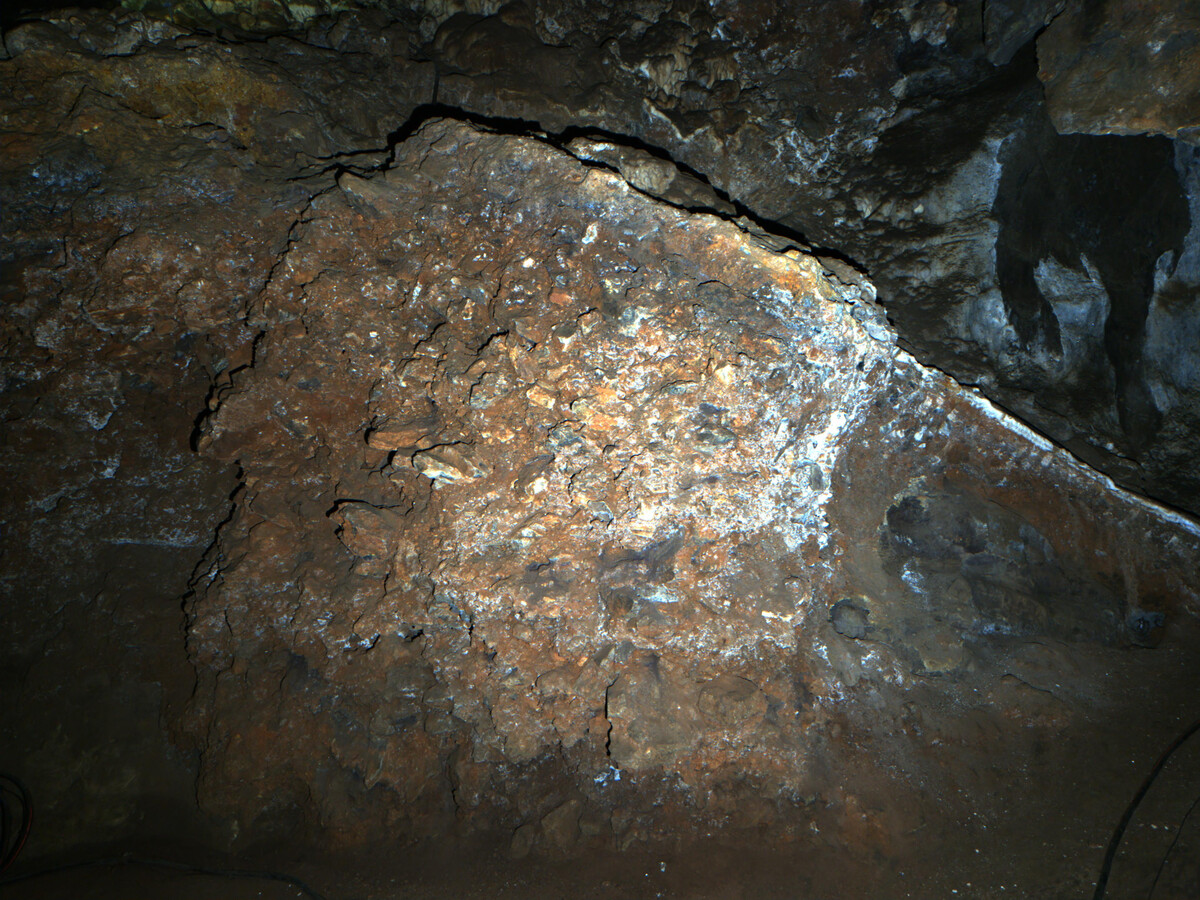
Sterkfontein Caves

  • Only one clear RGB-SVF win: D6.
  • D3 and D5 are not good enough.
  • Illumination changes dominate.
  • No cave claim yet.
DomainNoise / nuisanceGeometry controlWhat it testsCurrent verdict
RawNeRF SharpshadowCalibrated Poisson–Gaussian x0/x4/x16/x64One clean PINHOLE COLMAP solutionLoss robustness and representation ceilingClear strong-noise gain
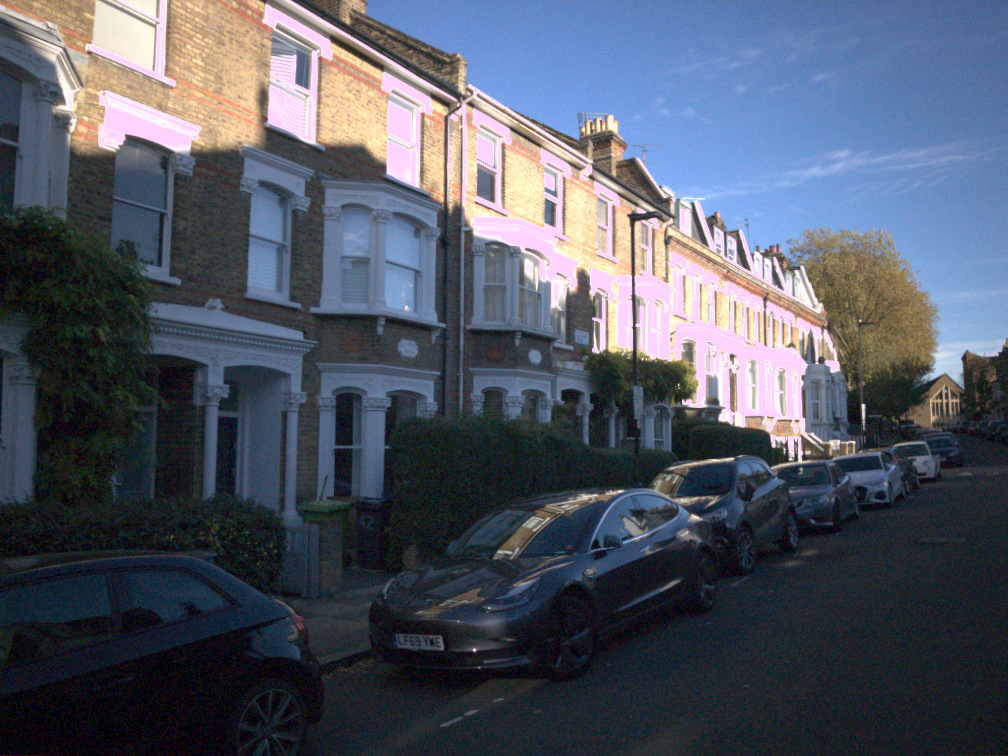
Dark3RReal exposure-dependent RAW noise; 1.1–5.3 dB mean SNR in Chapel sweepReference poses in current GS studyReal low-light transferScene/exposure dependent
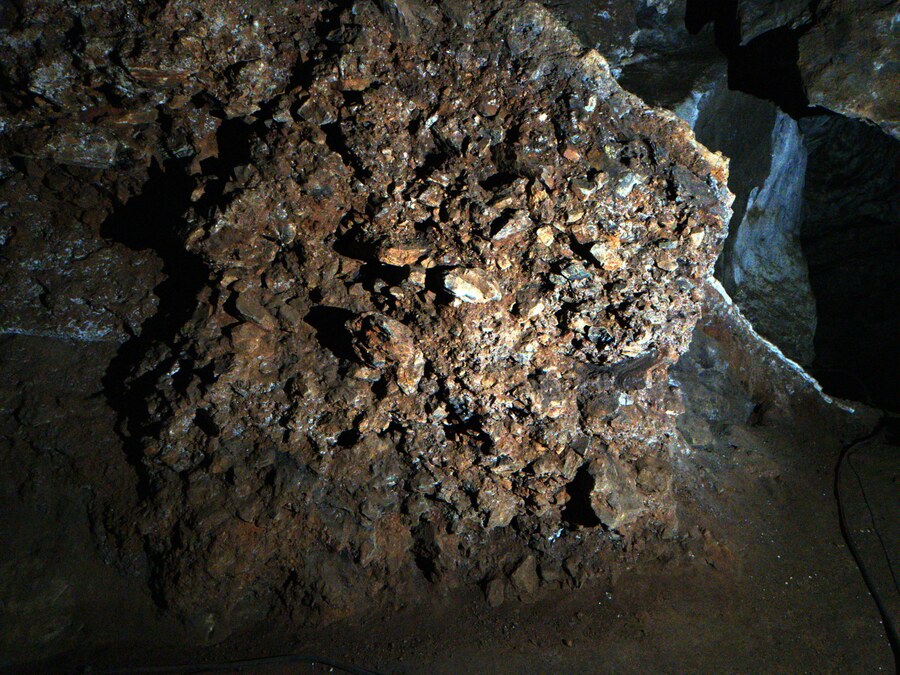
Cave D3/D5/D6Noise + spotlight + shadows + clipping + low textureOfficial reference COLMAPGeneralization beyond stationary sensor noiseNo universal improvement
03 · Current fixed backbone

RGB-SVF makes RAW residuals closer to homoscedastic before 2DGS sees them.

  • One calibrated shot/read model per RGB channel.
  • No learned denoiser.
  • No clean training target.
  • No 10 dB threshold.
  • No test-time module.
Linear RAW-derived RGBNoisy observation I and rendered image R remain in camera-linear space.
Per-channel calibrationUse fixed (aR,aG,aB) and (rR,rG,rB).
RGB-SVF transformApply the normalized stable variance function Tc to target and render.
2DGS-MCMCOptimize geometry, opacity and SH under the transformed L1 + SSIM objective.
Optional extensionTexture refinement or persistent geometry control is isolated as an ablation.

Simpler than NTF

  • No SNR knee.
  • No confidence exponent.
  • No two-slope ratio.

Why channel-wise?

  • R, G, B have different noise.
  • A scalar transform biases color.
  • E1 uses three fixed functions.

What it cannot fix

  • No cross-view reasoning.
  • Wrong splits may remain.
  • Large support may remain.
Display only.
  • GT-derived white balance.
  • Fixed ×32 exposure.
  • Same mapping for every method.
  • Metrics use linear float images.
04 · Formula and implementation

The current objective in full.

  • Linear heteroscedastic sensor model.
  • Independent calibration for each RGB channel.
1 · Noise model
\[ \operatorname{Var}\!\left(I_c \mid x_c\right) = a_c x_c + r_c^2, \qquad c\in\{R,G,B\}. \]
  • \(a_c\): shot noise.
  • \(r_c\): read-noise standard deviation.
  • Fixed during training.
2 · Stable variance function
\[ T_c(x) = \frac{ \sqrt{a_c x+r_c^2}-r_c }{ \sqrt{a_c+r_c^2}-r_c }, \qquad x\in[0,1]. \]
  • Inverse standard-deviation scaling.
  • \(T_c(0)=0\), \(T_c(1)=1\).
  • Continuous and threshold-free.
3 · Numerically stable implementation
\[ T_c(x) = x\, \frac{ \sqrt{a_c+r_c^2}+r_c }{ \sqrt{\max\!\left(a_c x+r_c^2,\,\varepsilon_v\right)} +r_c+\varepsilon }, \qquad \varepsilon_v=10^{-8}. \]
  • Avoids numerical cancellation.
  • \(a_c=0\Rightarrow T_c(x)=x\).
  • \(\varepsilon_v\) stabilizes black pixels.
4 · Photometric objective
\[ \begin{aligned} \Delta_{p,c} &=T_c\!\left(R_{p,c}\right)-T_c\!\left(I_{p,c}\right),\\[3pt] \mathcal{L}_{\mathrm{RGB\text{-}SVF}} &= 0.8\, \frac{1}{3|\Omega|} \sum_{p\in\Omega} \sum_{c\in\{R,G,B\}} \left|\Delta_{p,c}\right|\\ &\quad+ 0.2\left[ 1-\operatorname{SSIM}\!\left(T(R),T(I)\right) \right]. \end{aligned} \]
  • Same transform for render and target.
  • Renderer is unchanged.
  • No inference overhead.
Implementation.
  • One vectorized transform.
  • Three shot coefficients.
  • Three read-noise values.
  • Standard L1 + SSIM.
05 · RawNeRF controlled study

Strongest causal evidence: calibrated synthetic noise.

  • Same clean PINHOLE poses at every level.
  • Same held-out clean targets.
  • x0 / x4 / x16 / x64 scale calibrated Poisson–Gaussian variance.
  • Not fixed-σ RGB Gaussian noise.
NoiseVanilla 3DGSNTF-v1 2DGSRGB-SVF 2DGSSVF − VanillaReading
x027.990 / .89521 / .2354229.373 / .93242 / .1228229.079 / .93289 / .12048+1.089 dBnear tie with NTF
x428.269 / .89327 / .2385126.787 / .91506 / .1402430.145 / .93735 / .11172+1.876 dBSVF wins all metrics
x1627.712 / .88404 / .2407027.828 / .91373 / .1333130.068 / .92933 / .11427+2.356 dBSVF avoids NTF blur
x6426.110 / .83873 / .2566828.007 / .88195 / .1389228.942 / .89007 / .12061+2.831 dBbest loss-only result
RawNeRF x64 ground truth
Clean targetheld out
RawNeRF x64 Vanilla
Vanilla 3DGS26.110 dB
RawNeRF x64 NTF
NTF-v1 2DGS28.007 dB
RawNeRF x64 RGB-SVF
RGB-SVF 2DGS28.942 dB
x64 representation studyPre-trainingTexture refinementPSNRSSIMLPIPS
Standard Texture-GSLinear 2DGSLinear30.077.8882.0955
NTF-TGNTF 2DGSLinear31.561.8939.0927
Limits.
  • Current sweep uses 8-bit linear proxies.
  • Repeat with float/14-bit RAW.
  • Tree geometry remains imperfect.
06 · Dark3R real low-light study

Real evidence exists, but it is conditional.

  • Chapel 1/125–1/320: NTF is competitive.
  • Chapel 1/500: RGB-SVF wins.
  • Chapel 1/800: Vanilla wins.
  • Bookshelf: E1 wins by +2.008 dB.
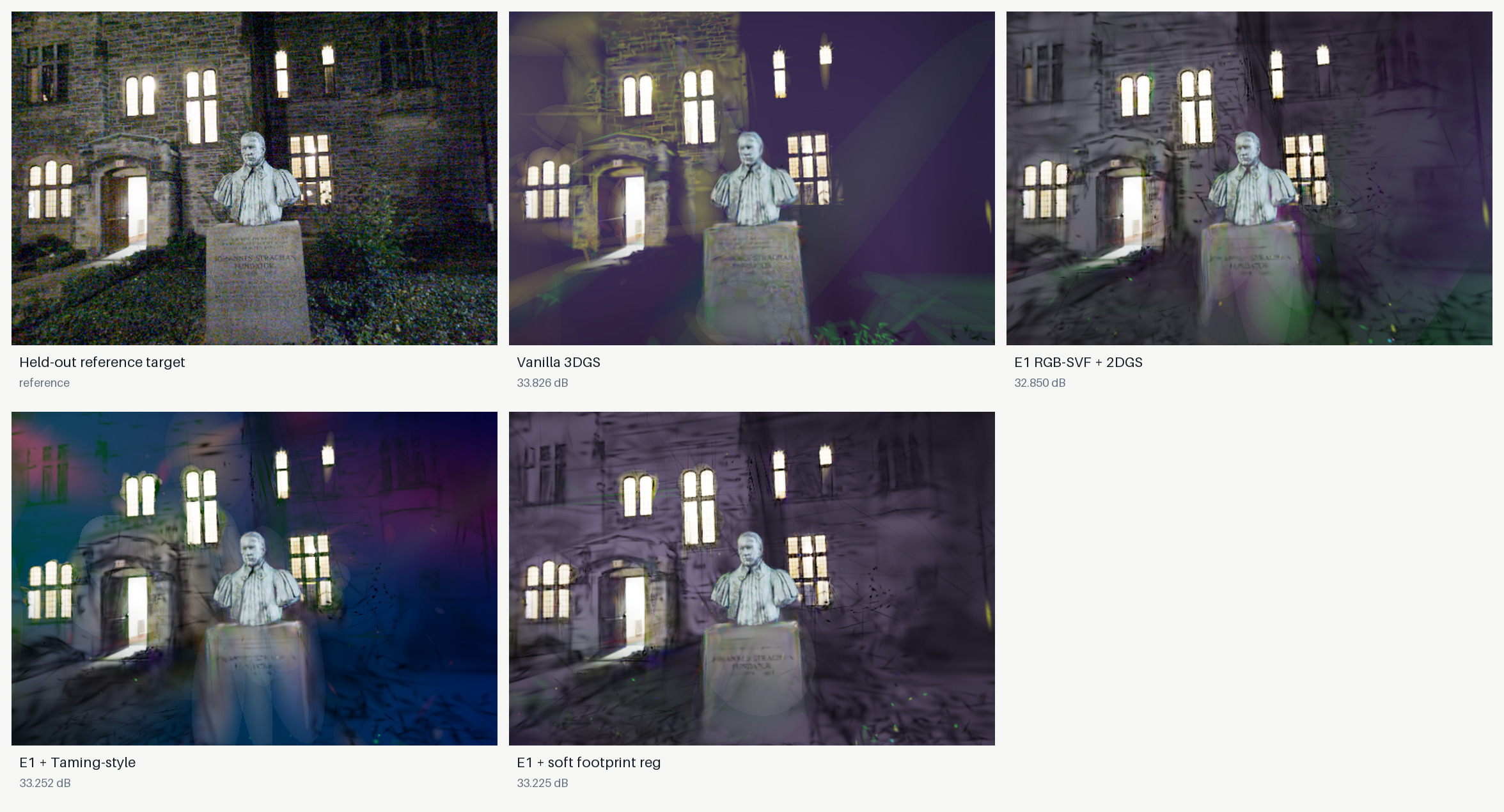
  • Statue: E1 loses by −0.977 dB.
Chapel exposureMean SNRVanilla 3DGSNTF-v1 2DGSRGB-SVF 2DGSWinner
1/1255.292 dB46.003 / .97258 / .02608*47.161 / .98088 / .0220246.295 / .97745 / .02422NTF
1/3202.556 dB43.583 / .95555 / .0386144.743 / .96828 / .0382644.324 / .96816 / .03593near tie
1/5001.682 dB43.487 / .95135 / .0491443.218 / .95652 / .0534044.589 / .96648 / .04301RGB-SVF
1/8001.102 dB41.356 / .92991 / .0638539.336 / .89475 / .0973839.855 / .90630 / .11019Vanilla
Fixed cross-scene protocolVanilla 3DGSE1 RGB-SVF 2DGSΔ PSNRInterpretation
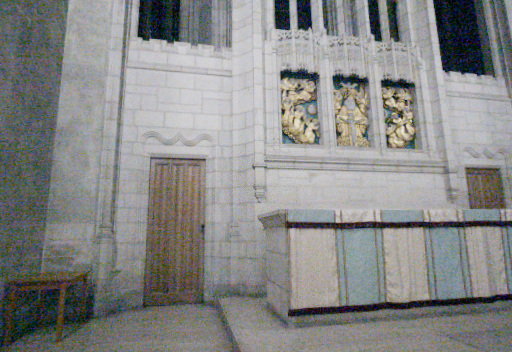
bc081 Bookshelf · 1/125 · 2.014 dB41.695 / .93343 / .0631543.703 / .96160 / .04001+2.008clear real-scene win
bc060 Statue · 1/100 · 2.260 dB33.826 / .93881 / .0476732.850 / .93739 / .04976−0.977geometry/artifact failure
Dark3R Bookshelf lossless float comparison
Dark3R Statue lossless float comparison
Evaluation.
  • Use lossless float renders.
  • Exclude earlier 8-bit PNG metrics.
  • Report aligned and unaligned results separately.
07 · Dark3R artifact diagnosis

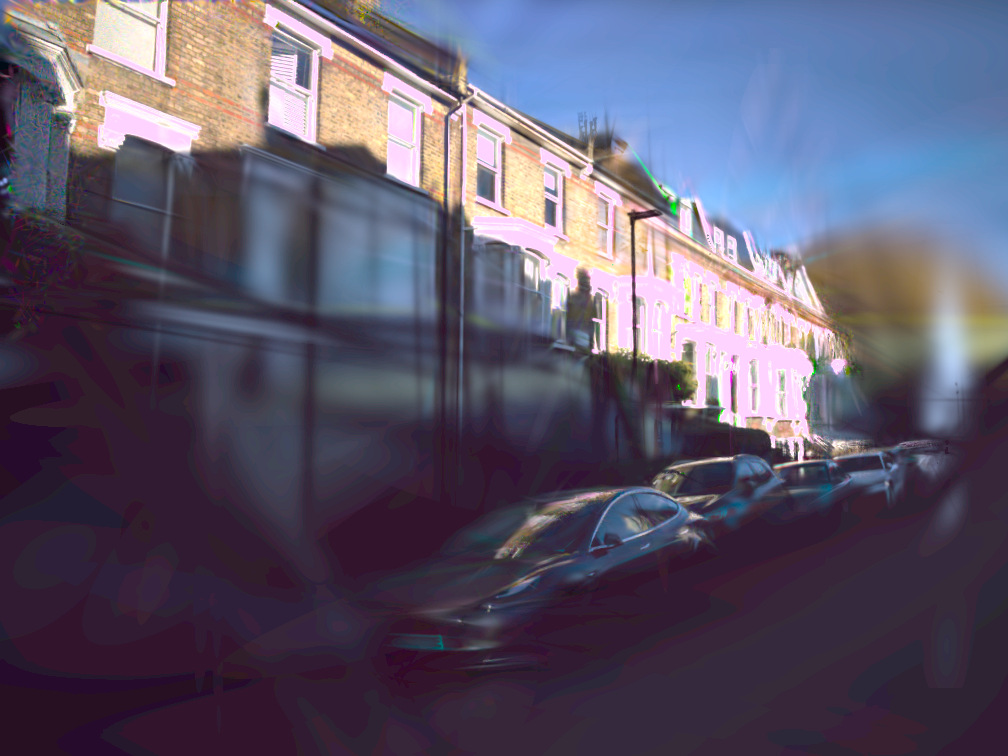
The visible blob is not just a color-loss problem.

  • Large projected footprint.
  • Low-to-medium opacity.
  • Weak position and scale constraints.
  • SH compensates for wrong support.
  • Result: translucent, view-dependent color fields.
Cause 1

Geometry gradients

  • Noise perturbs position and scale.
  • One-view errors may trigger growth.
  • Wrong support becomes permanent.
Cause 2

Path-dependent growth

  • Capacity is assigned early.
  • Later steps rarely repair topology.
  • Opacity and SH hide the error.
Cause 3

Appearance compensation

  • Large GS acts as color correction.
  • PSNR may increase.
  • Visual quality becomes worse.
Controlled attemptBookshelf PSNRStatue PSNRArtifact outcomeConclusion
E1 RGB-SVF backbone43.70332.850large splats remainreference
Taming-style importance relocation43.23133.252some tail change; artifact remainssymptom-level control
Translucent footprint regularizer43.18133.225some SSIM gain on Statue; artifact remainsglobal penalty harms useful coverage
Corrected Statue oraclePSNRSSIMLPIPSΔ PSNR vs E1What remains fixed
Current noisy E1 reconstruction32.850.93739.04976reference
Noisy geometry + cleaner 1/25 appearance34.341.94396.04434+1.491all geometry exactly frozen
Cleaner 1/25 geometry + noisy E1 appearance33.870.95747.03759+1.021all geometry exactly frozen
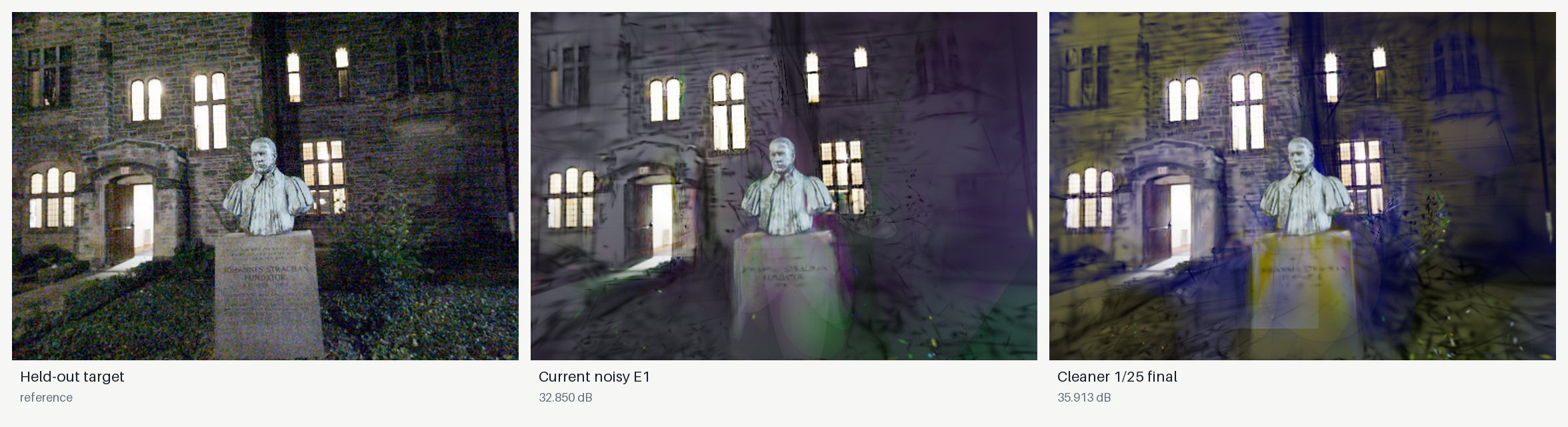
Cleaner geometry + cleaner appearance35.913.95561.03526+3.064upper reference
Dark3R target, noisy E1, and cleaner 1/25 final comparison
The oracle is not decisive.
  • The 1/25 “cleaner” model still contains large GS.
  • It is not ground-truth geometry.
  • The metric gains show sensitivity—not clean causal separation.
  • We need an external geometry prior or validated densification.
08 · Proposed unified extension

Keep RGB-SVF fixed; stabilize geometry with evidence that survives views.

  • Do not trust current GS depth.
  • Use cross-view parameter-gradient evidence.
  • Gate topology growth before appearance.
  • Optionally add Dark3R confidence as a soft prior.
RGB-SVF residualSame per-channel transform and hyperparameters across scenes.
K distinct camerasAccumulate world-space GS geometry gradients from different views.
Axis coherenceReal structure produces a persistent axis; random sensor noise is closer to isotropic.
Validated growthGate MCMC/splitting first; do not suppress ordinary geometry optimization globally.
Appearance refineTexture capacity only after topology stabilizes; freeze-geometry ablation remains mandatory.
Depth-free persistent axis confidence
\[ \begin{aligned} \mathbf{u}_{g,i} &= \frac{ \nabla_{\boldsymbol{\mu}_g}\mathcal{L}_i }{ \left\|\nabla_{\boldsymbol{\mu}_g}\mathcal{L}_i\right\|_2+\varepsilon },\\[3pt] \mathbf{M}_g &= \operatorname{EMA}_{i} \!\left( \mathbf{u}_{g,i}\mathbf{u}_{g,i}^{\mathsf T} \right). \end{aligned} \]
\[ c_g = \operatorname{clip}_{[0,1]} \!\left[ \frac{1}{2} \left( \frac{ 3\left\|\mathbf{M}_g\right\|_{\mathrm F}^{2} }{ \operatorname{tr}\!\left(\mathbf{M}_g\right)^{2} } -1 \right) \right]. \]
  • \(c_g=0\): isotropic directions.
  • \(c_g=1\): one persistent axis.
  • Outer product removes gradient-sign ambiguity.
Soft external geometry anchor for Dark3R
\[ \begin{aligned} \mathcal{L}_{\mathrm{prior}} = \lambda(t)\sum_g q_g \Big[ &\rho\!\left( \widehat{\mathbf n}_g^{\mathsf T} \bigl( \boldsymbol{\mu}_g-\widehat{\boldsymbol{\mu}}_g \bigr) \right)\\ &+ \eta \left\| \left( \mathbf I- \widehat{\mathbf n}_g\widehat{\mathbf n}_g^{\mathsf T} \right) \left( \boldsymbol{\mu}_g-\widehat{\boldsymbol{\mu}}_g \right) \right\|_1 \Big]. \end{aligned} \]
  • Prior source: external Dark3R pointmap and confidence.
  • Do not use current GS depth.
  • \(\rho(\cdot)\): robust normal constraint.
  • Second term: weak tangential anchor.
  • \(\lambda(t)\): decays to a small floor.

Gate topology first

  • Start with MCMC relocation/splitting.
  • Do not suppress all geometry gradients.
  • Avoid the V1 collapse.

Validate candidates

  • Test each new child on extra views.
  • Keep it only if residual decreases.
  • Reject unsupported growth.

Use one stop rule

  • Current gains peak at 7k–15k.
  • Use validation-based stopping.
  • No scene-specific iteration tuning.
09 · Experiment ledger

What has been tried—and what each result means.

  • Keep validated evidence.
  • Keep failed branches as ablations.
  • Do not combine modules without attribution.
Keep

NTF-v1

  • Boss-proposed origin.
  • Clear synthetic x64 gain.
  • Keep as conceptual ablation.
Keep as backbone

RGB-SVF + 2DGS

  • Simple and threshold-free.
  • Best loss-only synthetic result.
  • Fixed E1 for real scenes.
Representation branch

NTF-TG / Texture-GS

  • 31.561 dB at synthetic x64.
  • Strong Cave LPIPS.
  • Needs frozen-geometry attribution.
Diagnostic only

Consensus / forward teachers

  • Remove non-persistent noise.
  • Blur weak high-frequency detail.
  • Keep as diagnostic.
Early signal

Persistent axis confidence

  • D6 7k: +0.177 dB.
  • Gain disappears by 30k.
  • Needs validated growth.
Do not use

Signed-direction hard gating

  • Confidence collapsed near .02.
  • Suppressed 88% of geometry motion.
  • Sign assumption was wrong.
Not sufficient

Split geometry/appearance blur

  • Does not restore topology.
  • Removes useful high frequency.
  • Foliage becomes weaker.
Not sufficient

Taming / footprint penalties

  • Only modest metric changes.
  • Large splats remain.
  • Treats the symptom too late.
Limited diagnosis

Real geometry oracle

  • Freeze checks pass.
  • Cleaner 1/25 still has large GS.
  • Not ground-truth geometry.
10 · Paper story and next step

A compact story is possible—if the real geometry module generalizes.

  • RAW noise corrupts supervision.
  • It may also corrupt topology growth.
  • RGB-SVF protects the image objective.
  • Persistent/external confidence should protect geometry.
RAW sequenceLinear, float/14-bit, calibrated per-channel shot/read noise.
RGB-SVFThreshold-free robust photometric supervision.
2DGS backboneFast explicit scene representation with fixed evaluation protocol.
Persistent geometryCross-view gradient evidence + optional Dark3R soft prior.
Detail allocationValidated densification, then optional texture refinement.

Stage A · topology

  • Add the Dark3R soft prior.
  • Add cross-view growth validation.
  • Test one fixed configuration.

Stage B · appearance

  • Freeze trusted geometry.
  • Compare SH and Texture-GS.
  • Use one supervision schedule.

Stage C · real evidence

  • Bookshelf.
  • Statue.
  • Chapel 1/320–1/500.
Minimum publishable evidence.
  • Repeat the synthetic sweep in float/14-bit RAW.
  • Win on a defined real-data class.
  • Remove large-splat artifacts visually.
  • Report aligned and unaligned metrics.
  • Report runtime, GS count, and failures.
11 · Sterkfontein Cave study

Cave transfer is not good enough yet.

  • D3: RGB-SVF is below Vanilla.
  • D5: Texture-GS wins; RGB-SVF is below Vanilla.
  • D6: RGB-SVF gives one positive result.
  • Lighting changes are stronger than a pure sensor-noise model.
  • No broad Cave claim yet.
D3 · 30kPSNRSSIMLPIPSReading
Vanilla 3DGS20.339.6339.5296strong pixel baseline
Vanilla 2DGS20.312.6339.5156matched representation control
NTF + 2DGS20.402.6364.5069small gain
RGB-SVF + 2DGS20.254.6324.5104below Vanilla
Standalone Texture-GS20.208.6096.4056best LPIPS only
Factor-4 · 30kVanilla 2DGSNTF 2DGSRGB-SVF 2DGSTexture-GSWinner
D5 · proxy SNR 2.02 dB14.409 / .23062 / .7042214.421 / .23348 / .7083214.156 / .22100 / .7092614.639 / .22339 / .61827Texture-GS
D6 · proxy SNR 5.54 dB17.369 / .43477 / .4824417.454 / .43371 / .4954617.856 / .43373 / .4770217.344 / .41638 / .43360RGB-SVF
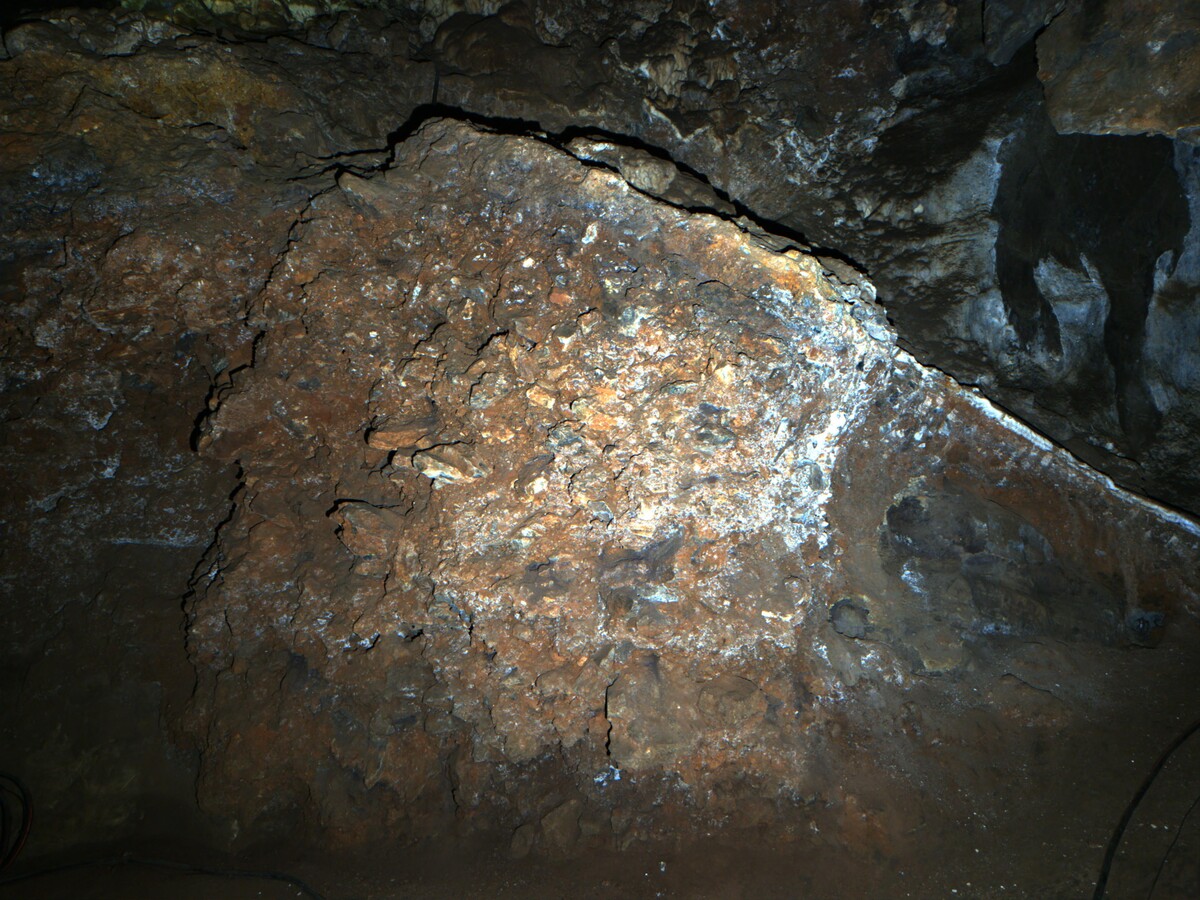
Cave D3 target
HDR+ targetD3 held out
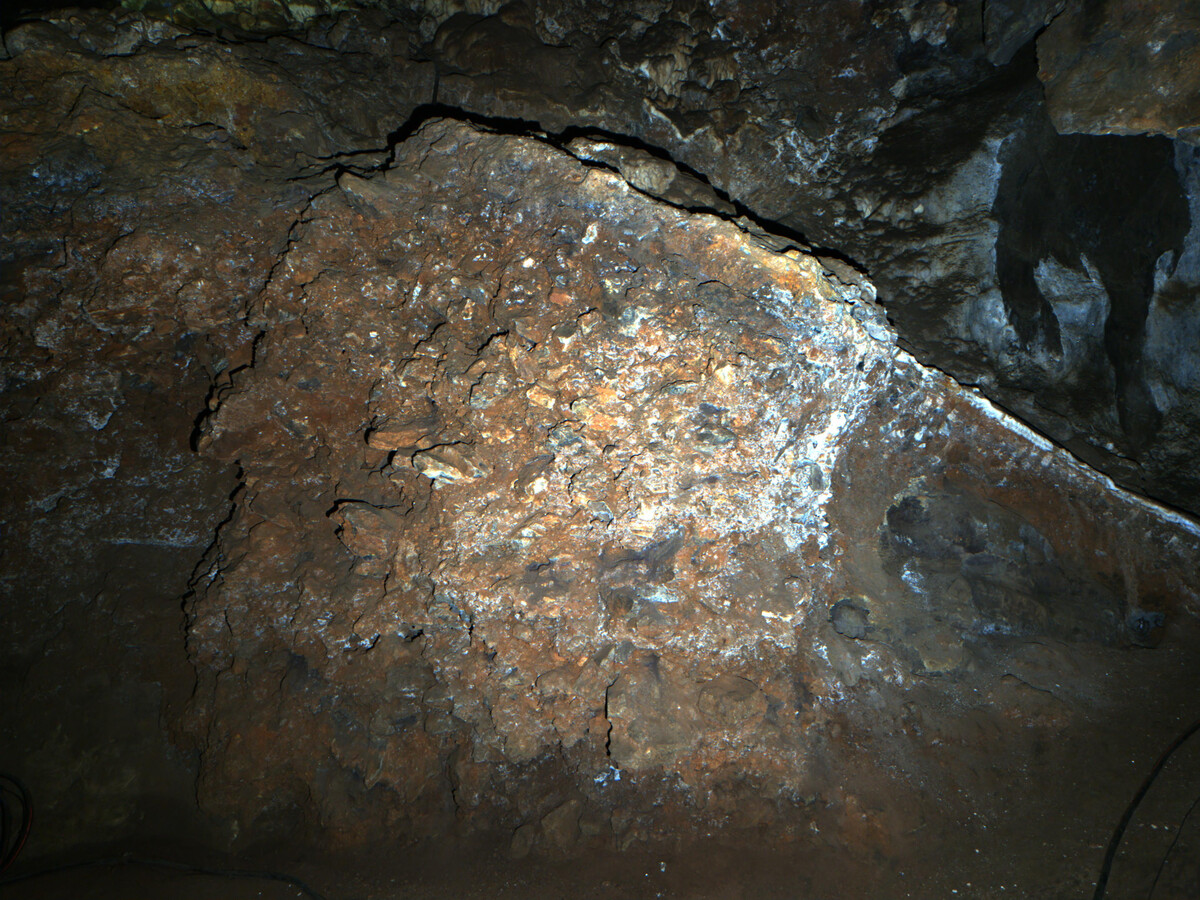
Cave D3 Vanilla 3DGS
Vanilla 3DGS20.339 dB
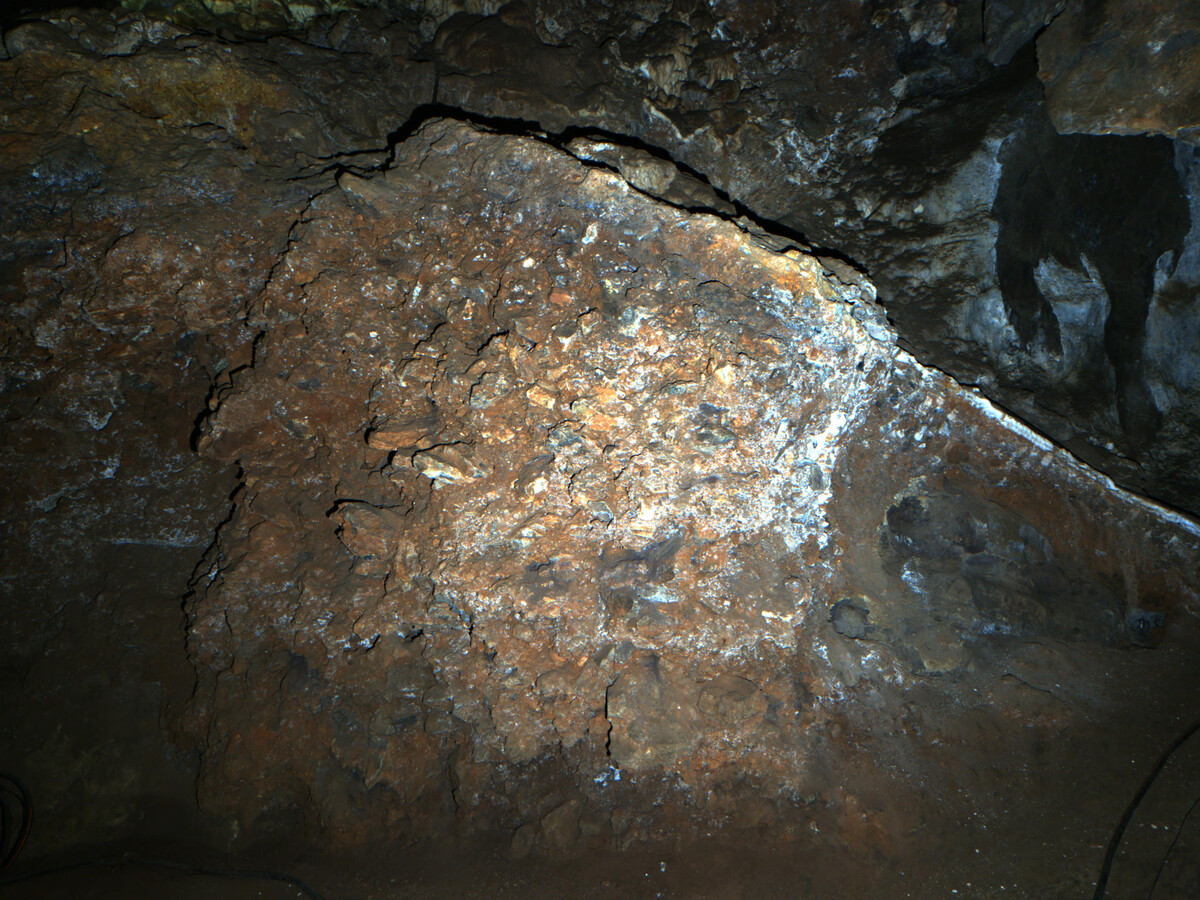
Cave D3 NTF 2DGS
NTF 2DGS20.402 dB
Cave D3 Texture GS
Texture-GSLPIPS .4056
Current conclusion.
  • Cave is not the main positive benchmark.
  • D6 is encouraging, but not sufficient.
  • Keep Cave as a difficult generalization test.