RAW-Noise Reconstruction · Maintained Experiment Record

NTF works. Textured Gaussians raise the ceiling.

At matched 30k pre-training + 7k texture refinement, NTF-TG reaches 31.561 dB on calibrated ×64 RAW noise—1.484 dB above the standard Textured Gaussians pipeline.

31.561 dBNTF-TG at the matched 37k checkpoint
+1.484 dBover Standard Textured Gaussians
30kfinal textured primitives
×64 noise
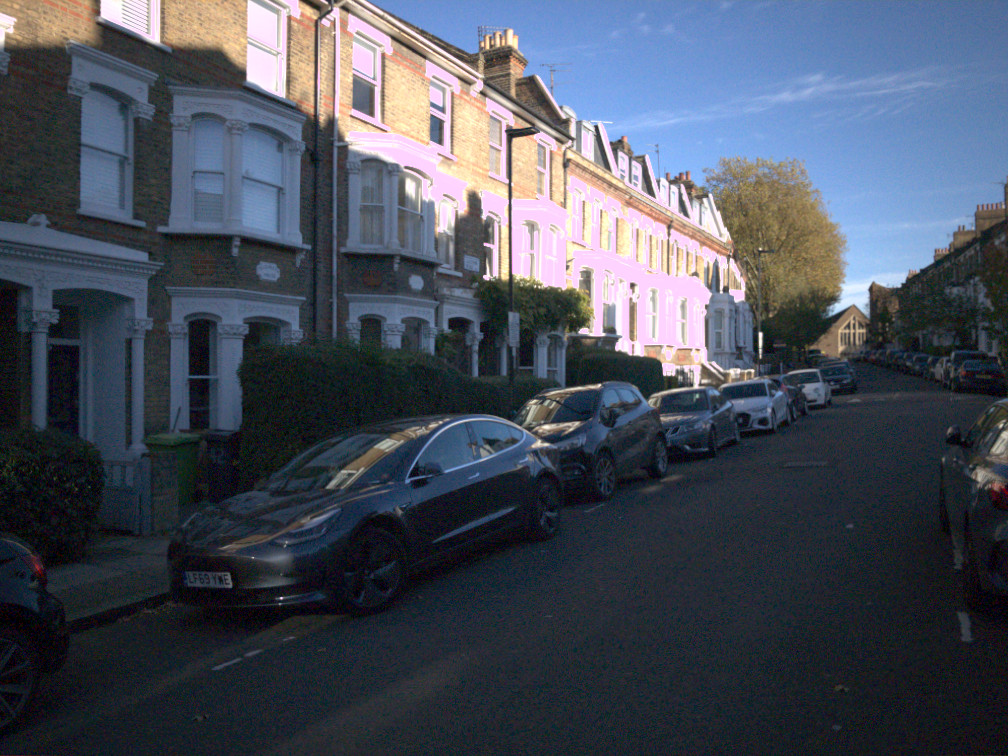
Clean held-out target
Clean targetheld out
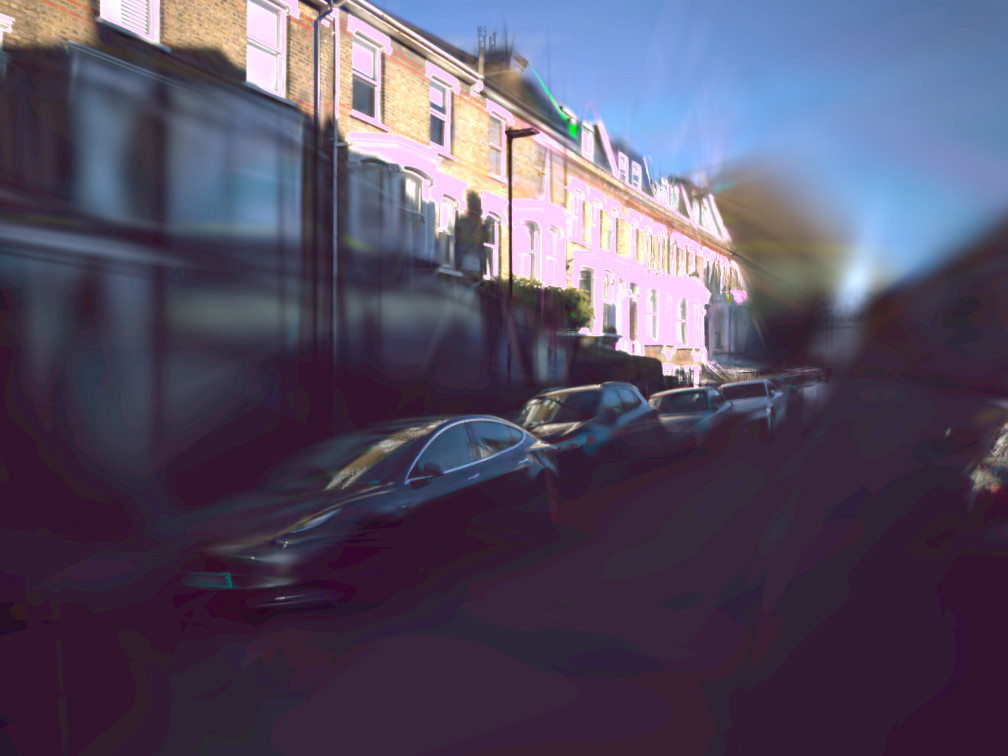
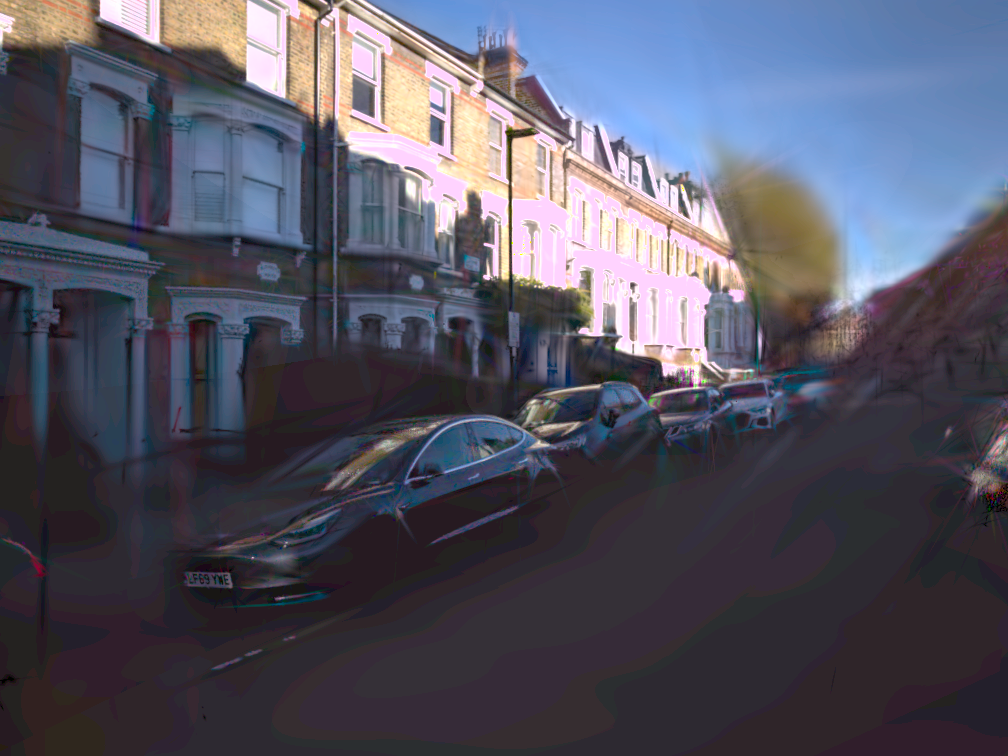
Vanilla 3DGS render
Vanilla 3DGS185,472 GS
PSNR26.110
SSIM.839
LPIPS.257
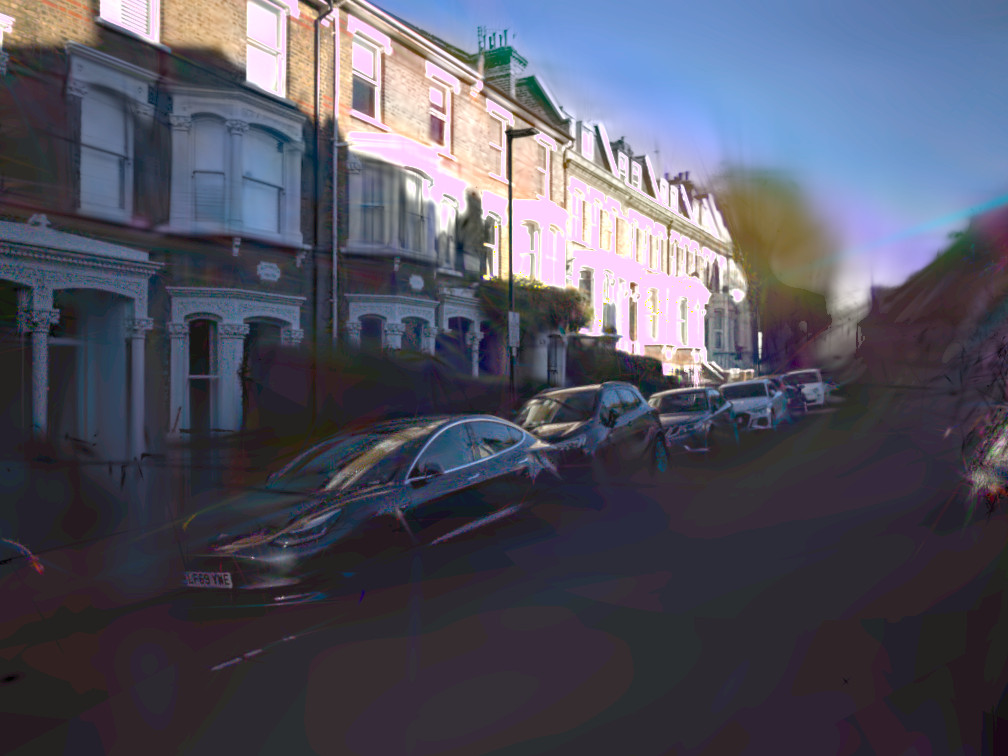
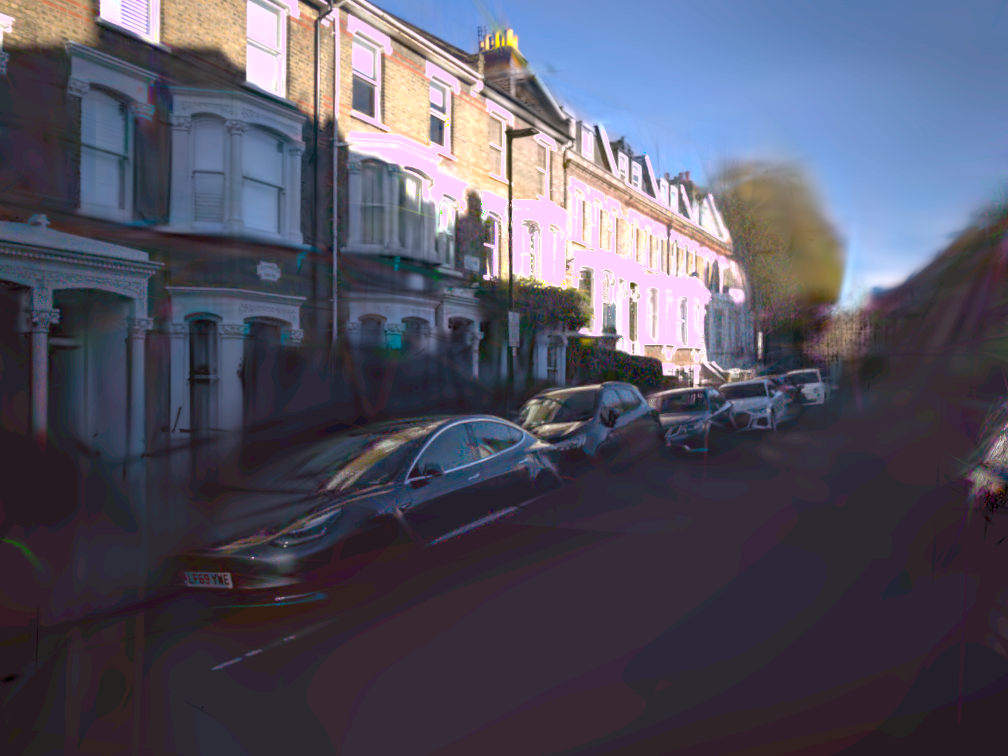
NTF-v1 render
NTF-v1175,689 GS
PSNR27.779
SSIM.868
LPIPS.180
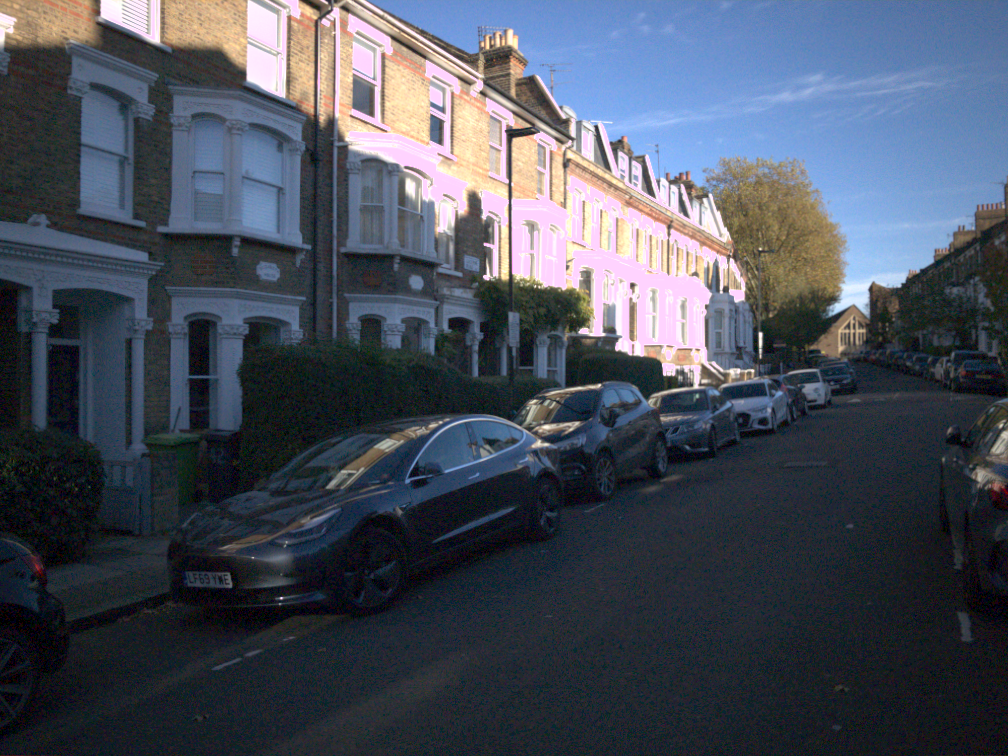
Best NTF-TG render with fixed display ISP
NTF-TGcurrent best
PSNR31.618
SSIM.893
LPIPS.092
Foundation and current ceiling. The visual row records the original NTF-v1 3DGS evidence: +1.669 dB over Vanilla at ×64. The new matched-budget result shows that inserting NTF into the standard Textured Gaussians pre-training stage adds a further +1.484 dB over Standard TG.
02 · How NTF works

Match the loss to RAW sensor uncertainty.

NTF is an analytic training objective, not a learned denoiser. It uses the calibrated shot/read-noise model to reduce unreliable dark residuals while keeping useful gradients and structural supervision.

Camera-linear observationNoisy RAW-derived target I and Gaussian render R
Noise varianceσ²(x) = a·x + r² from shot and read noise
Adaptive transfer TContinuous two-slope asinh; lower sensitivity below 10 dB SNR
SNR confidence wDark, uncertain pixels contribute smoothly less, without a hard binary mask
Gaussian updateConfidence-weighted L1 + transformed-domain SSIM
1 · Sensor noise and notation
I = observed camera-linear target,  R = Gaussian render,  σ²(Y) = aY + r²
Y is linear luminance; a is the calibrated shot-noise coefficient; r is the calibrated read-noise standard deviation. The same fixed parameters are used for every pixel and view.
2 · Target-SNR transition
τ = 1010/20,  xτ = ½[τ²a + √(τ⁴a² + 4τ²r²)],  xτ ← clip(xτ, xmin, 1)
xτ is exactly the signal level where x/√(ax+r²) reaches the chosen 10 dB SNR. Below it, the loss becomes less sensitive to unreliable intensity changes.
3 · Normalized asinh coordinate and slopes
xmin = 1/(214−1) = 1/16383,  u(x) = asinh(x/xmin)/ln2
uτ=u(xτ),  umax=u(1),  ρ=0.125,  shigh=1/[ρuτ+umax−uτ],  slow=ρshigh
16383 is the maximum integer value of a 14-bit RAW signal. The slope normalization makes T(1)=1. We originally considered log, but asinh(x/xmin)≈x/xmin near zero: it is locally linear and keeps a finite, non-zero gradient at black, whereas log requires clamping and gives unstable or dead gradients there.
4 · Complete two-slope transfer
T(x) = slow·u(x)if x ≤ xτ slow·uτ + shigh·[u(x)−uτ]if x > xτ
The low-SNR branch has one eighth of the high-SNR slope. The two branches meet continuously at xτ; there is no hard intensity cutoff.
5 · Per-pixel confidence
Y(I)=0.2126IR+0.7152IG+0.0722IB,  SNR(I)=Y(I)/√[aY(I)+r²+ε]
w(I)=clip[SNR(I)/τ, 0, 1]γ,  γ=1
Confidence is computed from the noisy target, detached from backpropagation, and shared by its three color channels. It rises smoothly from zero to one as the observation reaches the target SNR.
6 · Final NTF objective
Ldata = Σp,c wp|T(Rp,c)−T(Ip,c)| / [3Σpwp+ε]
LNTF = 0.8·Ldata + 0.2·{1−SSIM[T(R),T(I)]}
The first term suppresses unreliable low-SNR residuals; transformed-domain SSIM keeps spatial structure. Both the render and target pass through exactly the same analytic transform.
WHY 01

Noise no longer dominates dark regions

The transform and confidence jointly reduce the optimization pressure to explain random low-SNR fluctuations as persistent scene content.

WHY 02

Gradients remain alive at black

Unlike a clamped logarithm, asinh has a finite non-zero derivative at zero, which matters when SfM initializes Gaussian color near black.

WHY 03

Reliable structure is retained

Higher-SNR pixels keep the steeper branch, while transformed-domain SSIM preserves spatial structure instead of reducing the objective to pixelwise smoothing.

What changes—and what does not. NTF changes only the training loss. It requires no clean target, no pre-trained denoiser, and no test-time module. In NTF-TG it forms the robust pre-trained backbone; standard linear texture refinement then recovers local high frequency.
03 · Current position

Separate supervision from representation.

The same ×64 Sharpshadow split reveals two consistent effects: noise-aware pre-training improves each compatible backbone, and local texture capacity raises the reconstruction ceiling.

Supervision / training3DGS2DGSTextured Gaussian
Noisy input directly26.11028.22130.077 30k+7k
Conservative multi-view teacher27.93528.88930.763 30k+7k
NTF throughout27.77929.14231.181 30k+7k
NTF pre-training → linear texture31.561 30k+7k
ROBUSTNESS

NTF remains the causal core

Within 3DGS, NTF-v1 gains +1.669 dB over Vanilla. Within the planar backbone, NTF-2DGS gains +0.921 dB over Raw 2DGS.

CAPACITY

Texture restores appearance frequency

Relative to NTF-2DGS, matched 7k texture refinement adds +2.419 dB and visibly restores part of the tree’s internal variation.

LIMIT

Leaf geometry is still missing

The tree silhouette remains a large blob. Texture improves appearance on the learned support; it cannot recover absent depth and occlusion boundaries.

04 · NTF + Textured Gaussians

Use the repository’s standard two-stage pipeline.

Textured Gaussians are officially optimized through 2DGS pre-training followed by texture refinement. We change the first-stage photometric objective—not the representation or training scaffold.

COLMAP / SfM seed15.5k points on the controlled Sharpshadow split
30k NTF pre-trainingplanar Gaussian backbone, MCMC growth to a 30k cap
7k linear texture refinementstandard RGB+alpha texture objective; topology growth disabled
NTF-TG31.561 PSNR · .8939 SSIM · .0927 LPIPS
Matched 37k methodStage 1Stage 2PSNR ↑SSIM ↑LPIPS ↓
Standard Textured GSLinearLinear30.0770.88820.0955
NTF-TG FullNTFNTF31.1810.88860.1098
NTF-TGNTFLinear31.5610.89390.0927
Tone-mapped clean target, NTF 2DGS, NTF full texture, and NTF initialization with linear texture refinement
Fixed tree-region comparison · shared display ISPTexture recovers internal appearance frequency; metrics remain camera-linear.
Method naming. “NTF-TG” is accurate: 2DGS pre-training is the standard optimizer warm-up of Textured Gaussians, not an additional proposed representation. The final model is Textured Gaussians.
05 · Controlled setting

Isolate reconstruction from pose failure.

The synthetic sweep changes only calibrated sensor noise. Every method and noise level shares the same clean PINHOLE COLMAP solution.

Bayer RAWRawNeRF Sharpshadow
Poisson–Gaussiancalibrated shot + read noise
Linear RGBdemosaic + f4 downsample
Fixed poses31 noisy train / 5 clean test
CONTROL

x0 / x4 / x16 / x64

The multiplier scales calibrated Poisson–Gaussian variance, not a fixed RGB Gaussian standard deviation.

CAUSAL QUESTION

What does noise do to GS?

With pose held fixed, degradation can be attributed to appearance optimization, geometry, and densification.

KNOWN LIMITATION

Current storage is 8-bit

Noise is injected before demosaicing, but the current model input is quantized linear RGB. The definitive sweep should retain float RAW-derived values.

Why not Dark3R SfM here? Re-estimating poses at each noise level would confound pose and reconstruction. Dark3R SfM belongs in the real low-light benchmark, with a separate optional synthetic pose stress test.
06 · Noise sweep

The advantage emerges as noise increases.

Confidence-weighted NTF is the safest current backbone, but low-noise compatibility is not fully solved. The main validated regime is strong noise.

PSNR change versus Vanilla

Confidence-linear candidate, 30k iterations. Single-seed values; final claims require three seeds.

x0
−0.11 dB
x4
−0.95 dB
x16
+0.54 dB
x64
+1.22 dB
NoiseVanillaConfidence NTFΔ PSNR
x027.99027.880−0.110
x428.26927.321−0.948
x1627.71228.253+0.541
x6426.11027.331+1.221
Clean target crop
Clean targetview 00004
Vanilla crop
Vanilla
Confidence NTF crop
Confidence NTF
Current conclusion. The method should be scoped around strong noise. The final design must be identity-like at x0/x4, begin improving at x16, and retain the clear x64 advantage without per-level hand tuning.
07 · Remaining failure

Better denoising does not guarantee correct geometry.

NTF suppresses noisy supervision, but weak real gradients can be suppressed with it. Fine foliage remains under-reconstructed and can collapse into large, view-stretched splats.

Clean tree target
Clean targetfine branches + foliage
Vanilla tree crop
Vanilla ×64noise fitting + unstable detail
NTF tree crop
NTF-v1 ×64cleaner, but still blurred
Strong noise
unreliable photometric gradients
Over-suppression
real weak edges resemble noise
+
Wrong densification
missing support or false splats
Interpretation. The x64 result validates the noise-aware objective, but the visible tree artifact prevents a “solved” claim. Geometry and appearance must be diagnosed separately.
08 · Oracle diagnosis

The failure is both appearance and geometry.

Two frozen-geometry oracles separate what was learned from noisy appearance supervision from what was irreversibly lost during geometry optimization.

Oracle clean target
Clean targetfixed display ISP
Clean geometry and x64 appearance oracle
Clean geometry + ×64 appearanceOracle 1
Global24.418
Tree ROI20.435
Tree grad26.271
x64 geometry and clean appearance oracle
×64 geometry + clean appearanceOracle 2
Global26.527
Tree ROI22.596
Tree grad27.943
Tree failure
observed artifact
=
Appearance suppression
clean supervision recovers +2.11 dB
+
Geometry deficiency
the large blob remains after clean appearance
Scientific conclusion. Appearance-aware supervision is necessary, but not sufficient. The remaining blob is direct evidence that densification and spatial support must also change.
09 · What we learned

Loss-only and hard densification fixes are insufficient.

The search has already eliminated several tempting explanations and narrowed the next method to a noise-aware appearance objective plus soft, budget-aware persistence.

Adaptive NTF render
Adaptive NTFstrong x64 objective
PSNR28.072
SSIM.870
GS198k
VST wavelet teacher render
VST-wavelet teacherbest specialized x64 run
PSNR28.132
Tree ROI24.336
GS229k
Hard persistent gradient render
Hard persistence gaterejected
PSNR21.278
Tree ROI19.087
GS52.6k
01

Confidence is the safest backbone

It nearly preserves x0 and becomes useful at x16/x64, but x4 compatibility still needs an identity-like gate.

02

A denoised teacher helps appearance

VST-wavelet improves tree-region pixels, yet the large geometric artifact remains.

03

Hard persistence under-densifies

Four-view binary rejection prevents false growth and real growth together. Persistence should be a soft score with a GS-growth budget.

Next design. Use NTF-TG as the single primary representation. First isolate texture with frozen geometry and RGB-only texture; then allocate texture capacity only to cross-view-consistent appearance detail while routing missing geometric detail to a separate densification study.
10 · Research story

Noise-aware pre-training, detail-safe texture refinement.

The controlled result now supports a compact story: NTF prevents strong RAW noise from corrupting the Gaussian backbone; standard texture refinement then restores local high frequency without asking the robust transform to preserve every weak detail.

Track A · Core method
calibrated RAW noiseNTF pre-trainingtexture refinement

Standard Textured Gaussian optimization with one controlled change: noise-aware formation of the pre-trained backbone.

Track B · Real extreme low light
14-bit RAWDark3R posedepth + confidence

The official Dark3R dataset supplies the real-noise benchmark and a strong Dark3R-NeRF target.

Calibrated RAW residualshot/read-noise-aware NTF supervision
NTF backbone formationrobust planar geometry, opacity, and SH
Stop topology growthstandard Textured GS refinement schedule
Detail-safe texturelinear RGB residual on reliable local structure
NTF-TGstrong-noise reconstruction with local detail capacity
Target: retain NTF robustness while matching high-frequency structure with one Textured Gaussian representation.
Standard TGVanilla 3DGSAbsGSSAD-GSRaw3DGS-styleDark3R-NeRFNTF-TG
Image preview
Expanded experiment image