Mixed exposures: why a VSF loss beats L1
15 Nov 2026 · Fei · checker toy, 3DGS, 3 seeds per number
Weight each view by its own noise.
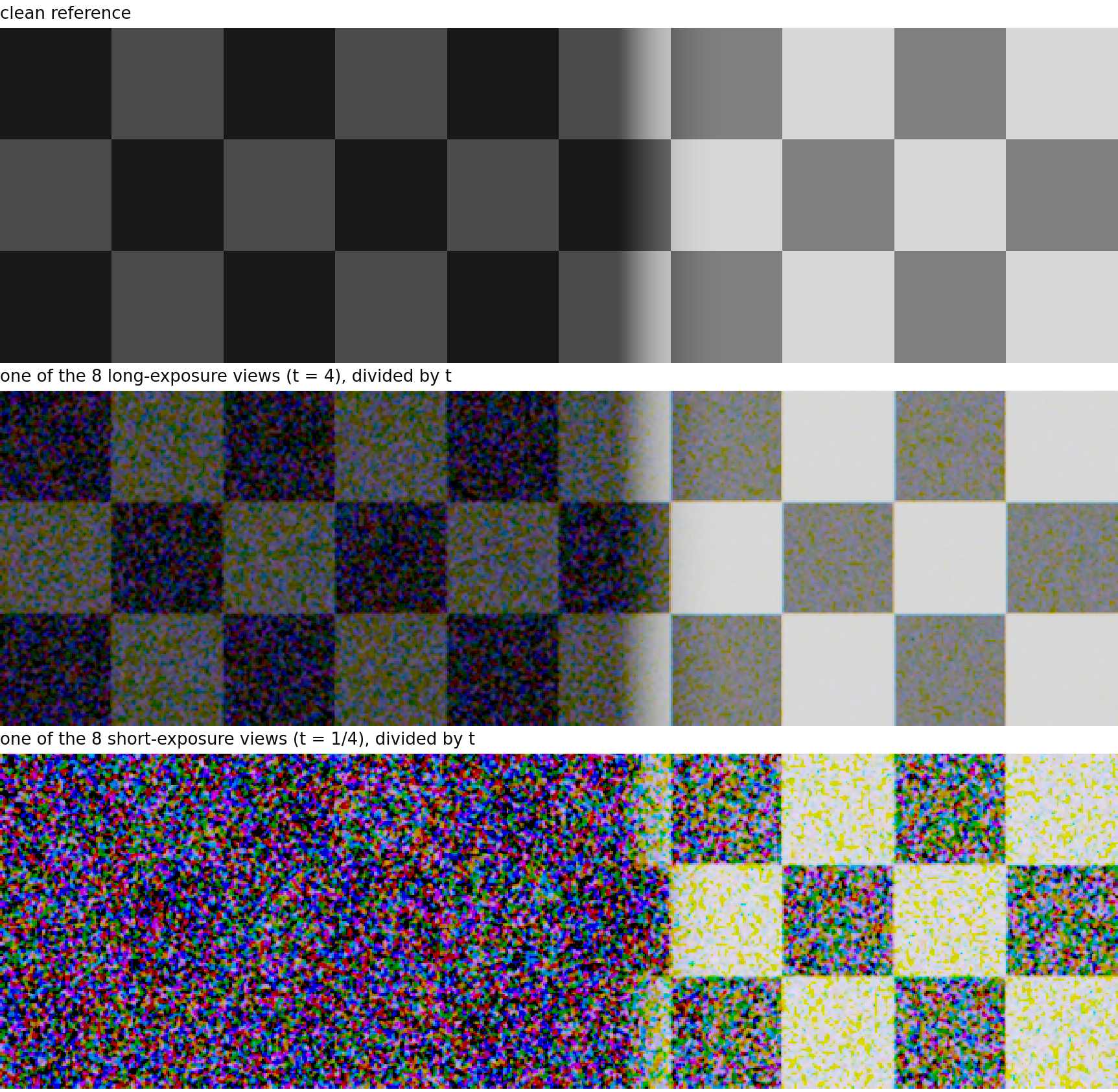
The signal grows in proportion to the exposure time t, but the noise does not: read noise stays the same and shot noise grows as √t. After dividing each frame by t, a t = 1/4 view is 7–16× noisier than a t = 4 view. L1 weights all views equally; VSF weights each view by 1/σi.
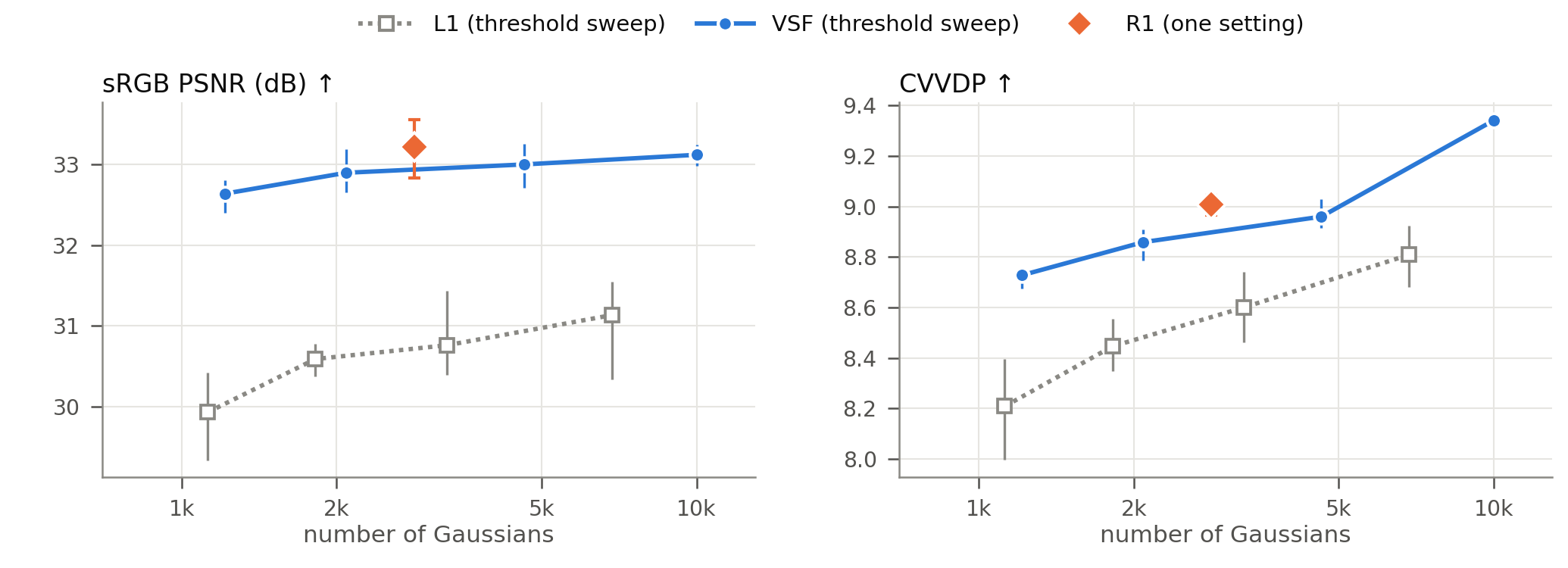
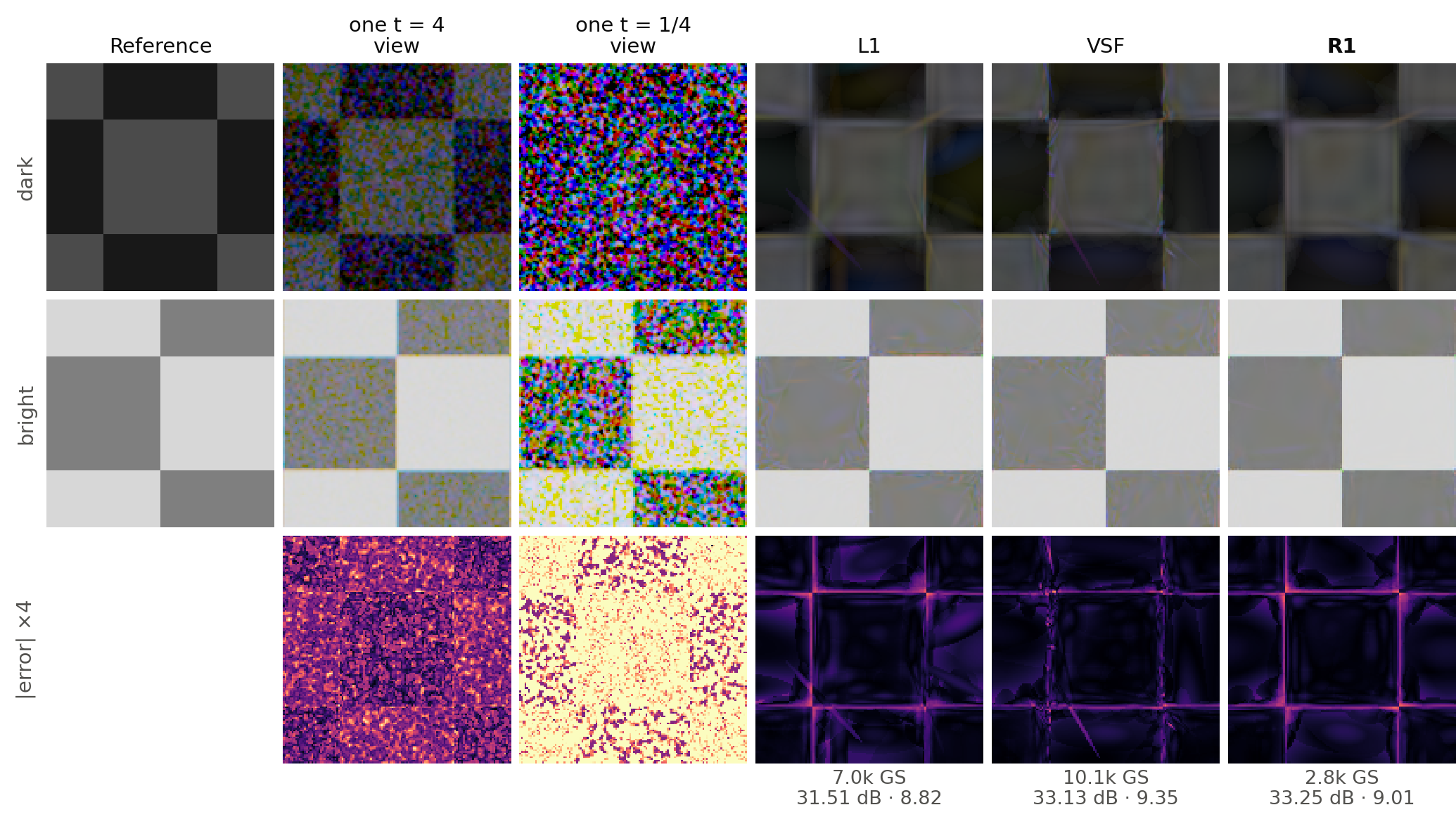
With 8 views at t = 4 and 8 at t = 1/4: L1 31.1 dB → VSF 33.1 dB (CVVDP 8.81 → 9.34); R1 33.2 dB with one setting. Adding the noisy views makes L1 worse than using the good views alone (32.4 dB).
Loss
Frame i is divided by its exposure ti, yi = rawi / ti, so every view has the same mean but noise
σi²(v) = a·v / ti + b² / ti²
VSF compares render r and observation yi after the variance-stabilising transform of that view:
L = Σi | φi(r) − φi(yi) |, φi(v) = ∫0v du / σi(u), ∂L/∂r = sign(r − yi) / σi(r)
So each view is weighted by its own 1/σi. L1 is the same loss with σi ≡ 1.
Toy
Exposure-ladder checkerboard with Dark3R noise; the 16 views alternate t = 4 and t = 1/4. Thresholds are swept and the best is reported; R1 has a single setting.
Results
| method | fitting loss (r = render, rawi = frame i, ti = its exposure) | best threshold | sRGB PSNR (3 seeds) | CVVDP | #Gaussians |
|---|---|---|---|---|---|
| L1 | Σi | r − rawi / ti | | τ 1.25e-5 | 31.13 ± 0.69 | 8.81 | 6.8k |
| VSF | Σi | φi(r) − φi(rawi / ti) | | τ 0.01 | 33.12 ± 0.13 | 9.34 | 10.0k |
| R1 | VSF loss; densify by the noise test (no threshold) | none | 33.21 ± 0.36 | 9.01 | 2.8k |
Using only the 8 t = 4 views: L1 32.45 dB.
Why
With an L1-type loss each pixel converges to a weighted median over the views, and the best weights are 1/σi. Monte Carlo of one pixel with this toy's noise, giving the error reduction relative to L1:
| pixel value | drop the noisy views | VSF |
|---|---|---|
| 0.0002 | +3.14 dB | +3.27 dB |
| 0.0016 (dark cell) | +3.03 dB | +3.17 dB |
| 0.0456 (bright cell) | +2.02 dB | +2.37 dB |
Equal weights let the noisy views pull every pixel, and, with one view per training step, they also dominate the update noise and the densification score.