selflimit_gateA self-limiting densification gate: R1 and R2
Low-light Gaussian splatting needs an allocation signal that sees dark detail, and a brake that stops it from fitting noise. We let an illumination-invariant score decide where to add Gaussians and a calibrated significance test decide whether the data support them. Growth then stops on its own once the residual is noise: no Gaussian cap and no per-dataset threshold tuning.
1 · Native density control fails in both directions
Each host thresholds a screen-space gradient of its own photometric loss. In the dark that statistic is miscalibrated:
- L1 hosts (3DGS) are dark-blind: the gradient scales with brightness, so Dark3R scenes stop at 13–41 k Gaussians.
- Relative-MSE hosts (Raw3DGS) are noise-blind: the gradient scales with 1/brightness. About half of all Gaussians cross the threshold at every event, and the model reaches 6–11 parameters per observed pixel value.
Our allocation score is relative L1 with a fixed scale λ = 1, so it sees dark structure like the same scene well exposed. It also amplifies dark noise, so a brake is required. The chart shows what happens with the old gate (R0), with a blind birth quota (Q) and with the new gates.
Show data
2 · Where vs whether
The gate leaves the host's clone/split/prune rules untouched. It only decides which candidates the host is allowed to densify. Both R1 and R2 use the same evidence. They differ only in how that evidence is combined with the host threshold.
3 · The test
For Gaussian $i$ and training view $t$, let $u_i$ be its projected 2-D centre and $\mu_p$ the clamped rendered value at pixel $p$. The allocation weight is relative: $w_p = 1/(\mu_p + \tau)$, $\tau = 10^{-3}$.
If the residual signs inside a footprint are noise, $g$ and $h$ have the same distribution and $z \approx 1$. A real misfit, such as an edge in the wrong place or a missing texture, makes the signs coherent with the footprint's sensitivity, and the signal energy adds up. Panel C shows the subtle case: demosaiced noise is spatially correlated, so it looks "coherent" to a pixel-independent null.
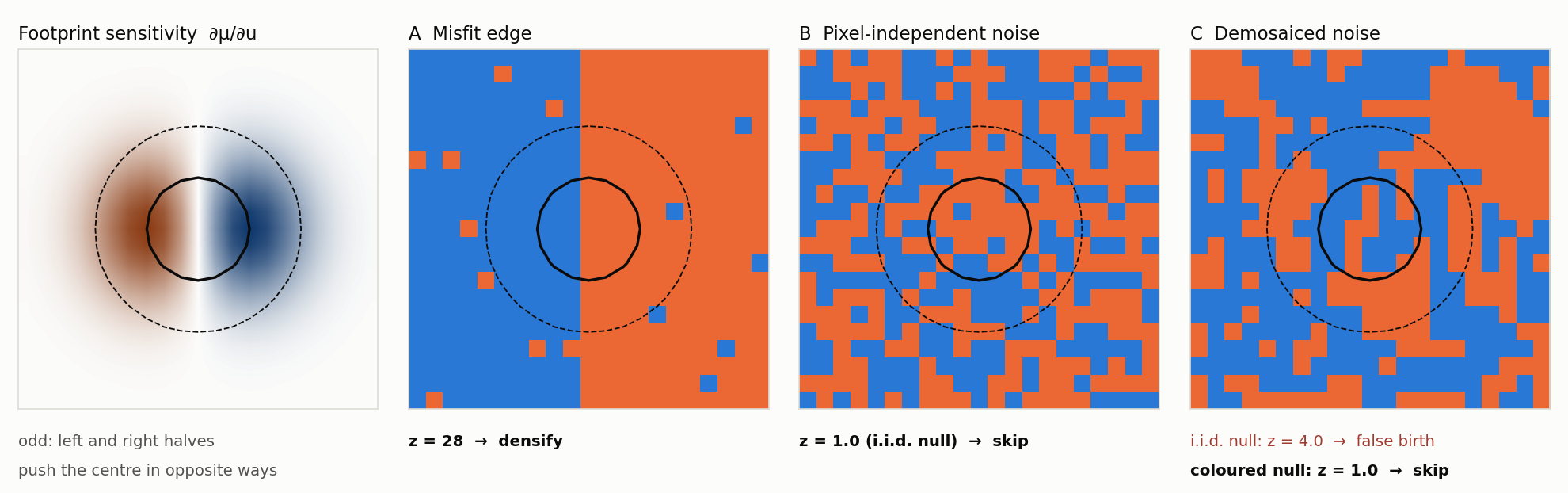
4 · Calibrating the null to the camera pipeline
The old gate (R0) used pixel-independent ±1 signs. Real low-light images are demosaiced and resampled, so neighbouring noise samples are correlated. We measure the sign autocorrelation once per dataset from a pure-noise residual: Dark3R uses low − 0.25 × long-exposure pairs, RawNeRF ×64 uses the strong64 − native difference. From it we build a small kernel $k$ such that $\operatorname{sign}(k*\xi)$ has the same autocorrelation.
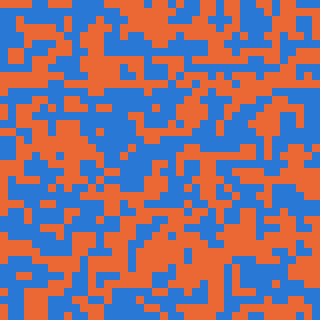
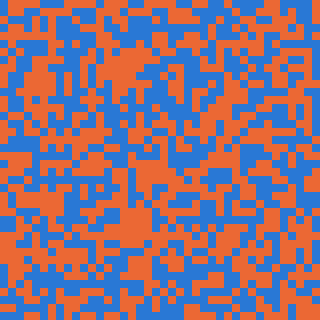
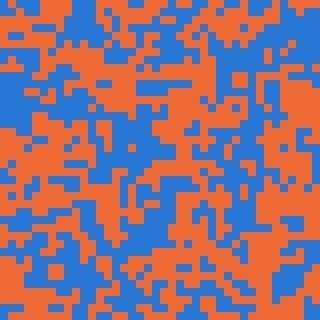
Same 40 × 40 crop size, one sign per pixel. The real patch is a flat region of a chapel training frame.
Show data
5 · R1 and R2
R1 · score and test recommended default
$$ \text{densify } i \iff \bar g_i \ge \tau_{\text{host}} \;\wedge\; z_i \ge q_i $$$\bar g_i = \frac1n\sum_t \lVert g_i^t\rVert$ is the host's own statistic. The allocation score at λ = 1 says where; the test says whether.
- Keeps the decoupling explicit: allocation and detection stay separate, which is the paper's story.
- α has a meaning: expected false births per event. Its false-positive rate is verified (§4).
- A filter on the host rule. The host statistic and threshold are unchanged.
R2 · one debiased score
$$ s_i = \sqrt{\max\!\big(0,\; S_g - q_i S_h\big)/n_i}\;\ge\;\tau_{\text{host}} $$The noise floor $q_i S_h$ is subtracted before thresholding. Only the excess, structured energy is compared with the host threshold.
- Elegant: a single number per Gaussian, and the gate disappears into the score.
- But it replaces the host statistic (mean norm → RMS excess), and α and τ_host interact.
- Keep as an ablation: "the same evidence, combined differently".
6 · Why it stops by itself
Early in training the model is under-fit: residual signs are coherent, z is large and the gate opens. As Gaussians absorb the structure, the residual becomes noise, z falls towards 1, below the critical value, and births stop. False births are bounded by α per event, about 95 over a whole run. The spike at 5k is the host's injection of 100k random points: they are briefly under-fit, the gate reopens, then closes again.
Show data
7 · First numbers
Screening run: Raw3DGS, 15k iterations, seed 42. Each cell gives sRGB PSNR / sRGB LPIPS / final #Gaussians. The reference columns use a 100k Gaussian cap, which the historical protocol needed. R1 and R2 run with no cap at all.
| scene | native @100k cap | old SN_G @100k cap | R1 · no cap | R2 · no cap | Q · 10k / event |
|---|
Uncapped native at 30k on the A800: chapel 12.67, statue 13.55, office64 10.32 dB. Full 30k runs with R1, R2, birth-matched controls and α sweeps are in progress: Raw3DGS and LE3D on the A800, 3DGS and Lumi-GS on iridium. The previous seed-42 report for 3DGS and Lumi-GS is here.
8 · Open points
- Possibly too strict. R1 stops at about 0.1 M Gaussians on Dark3R. On Lumi-GS, fewer Gaussians gave higher PSNR but a worse LPIPS. The α = 0.01 / 100 sweep will show the trade-off.
- Kernel slightly over-correlated. The Dark3R kernel was fit on whole frames (lag-1 0.32). Flat, noise-only tiles give 0.26, because moving foliage in statue inflates the estimate. A slightly wider null makes the test conservative, not anti-conservative. Refit on flat tiles before the final runs.
- Birth-matched control. Q@rpR1 replays R1's per-event birth counts but picks by score alone. It isolates "which Gaussians" from "how many", which answers the #Gaussians question directly.
- Uncertainty. Each result is a single seed so far. RawNeRF has one test view, so differences under about 0.5 dB there are not meaningful yet.