Objective
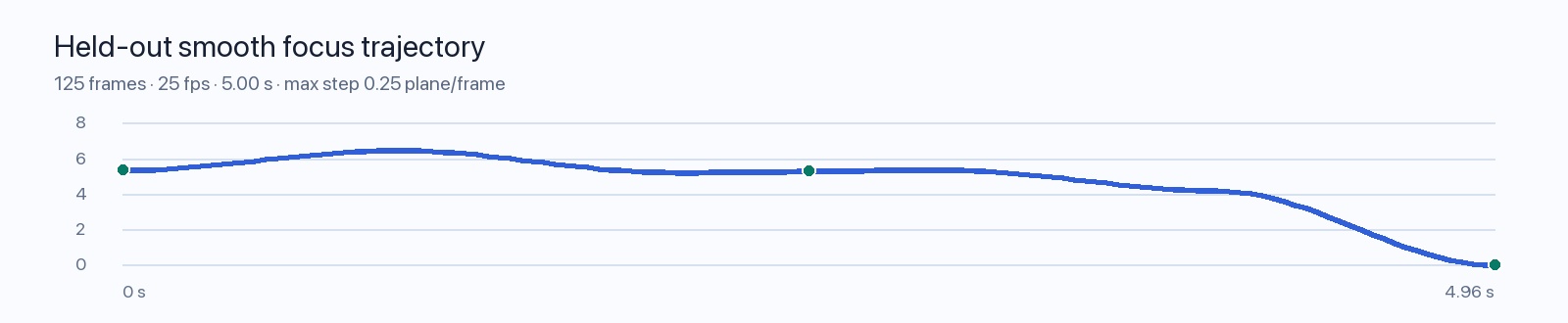
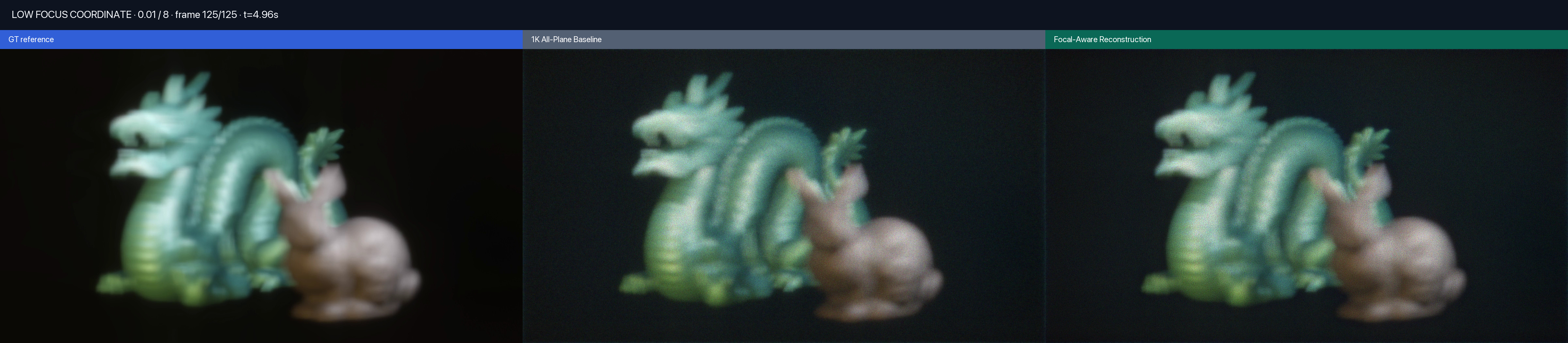
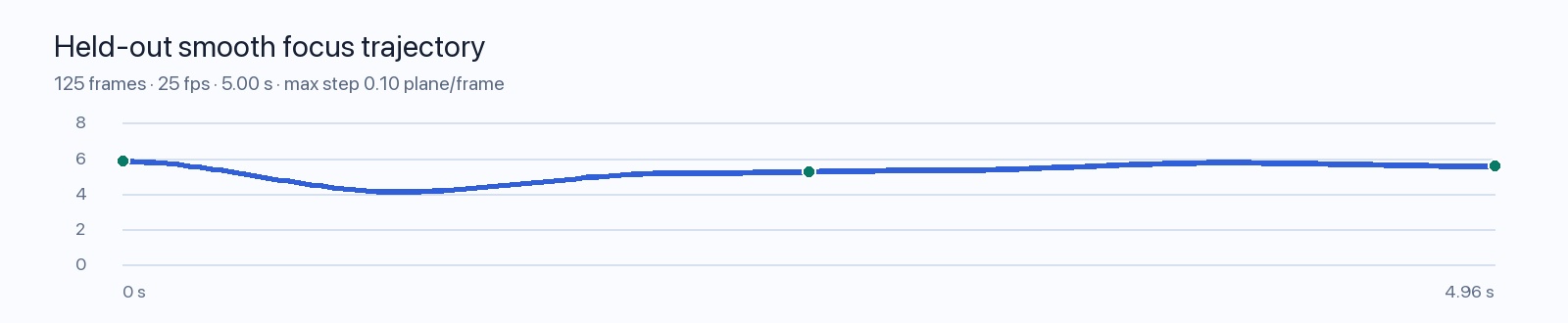
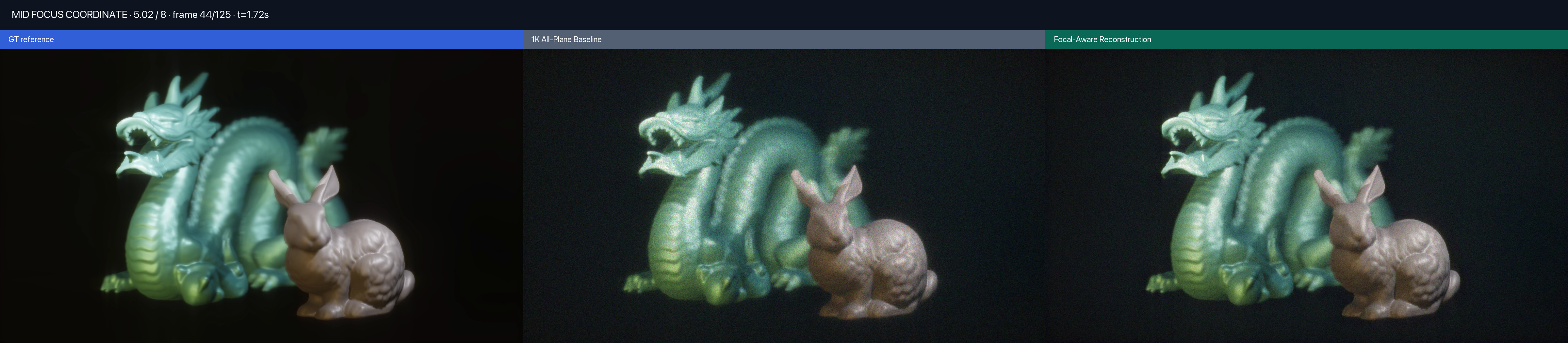
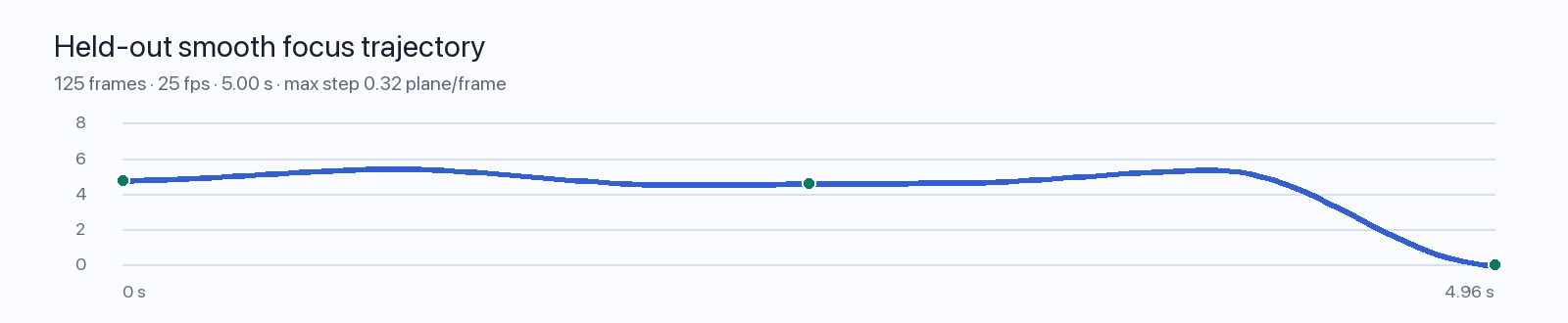
Four smooth 17-frame training trajectories sample continuous focal states. They are independent of the three held-out trajectories below.
Continuous focal render\[\widehat{F}_t=\operatorname{sRGB}\!\left(\sqrt{(1-\alpha_t)\widehat{A}_{\lfloor d_t\rfloor}^{,2}+\alpha_t\widehat{A}_{\lceil d_t\rceil}^{,2}}\right)\]
Full loss\[\mathcal{L}=\mathcal{L}_{\text{9-plane}}+\mathcal{L}_{\text{gaze}}+\lambda\!\left(\mathcal{L}_{\Delta}+0.1\,\mathcal{L}_{\text{CSF}}\right)\]
Focal-video difference loss\[\mathcal{L}_{\Delta}=\rho_{\epsilon}\!\left(\Delta\widehat{F}-\Delta F^{\star}\right)+0.25\,\rho_{\epsilon}\!\left(\Delta^{2}\widehat{F}-\Delta^{2}F^{\star}\right)\]
Gradient-balanced auxiliary weight\[\lambda=\rho\,\frac{\left\lVert\nabla_{\theta}(\mathcal{L}_{\text{9-plane}}+\mathcal{L}_{\text{gaze}})\right\rVert_{2}}{\left\lVert\nabla_{\theta}\mathcal{L}_{\text{aux}}\right\rVert_{2}}\]
Iterations 1–800: soft Gumbel, \(\rho=0.10\). Iterations 801–1000: hard-forward STE, \(\rho=12\).
Implementation branch ↗