DiagSplat · Round-1 bootstrap audit
All-30 transient: generated-trajectory comparison
This report compares three independently trained 30k models on the same scene. The video uses a newly generated smooth trajectory interpolating the 30 training camera poses—not a slideshow of the five test views. All methods receive exactly the same 238 poses at 800×532.
Masked vs raw PSNR+4.43 dB
Masked vs raw LPIPS-0.044
Trajectory238 frames30 fps · ping-pong loop
Side-by-side novel-view video
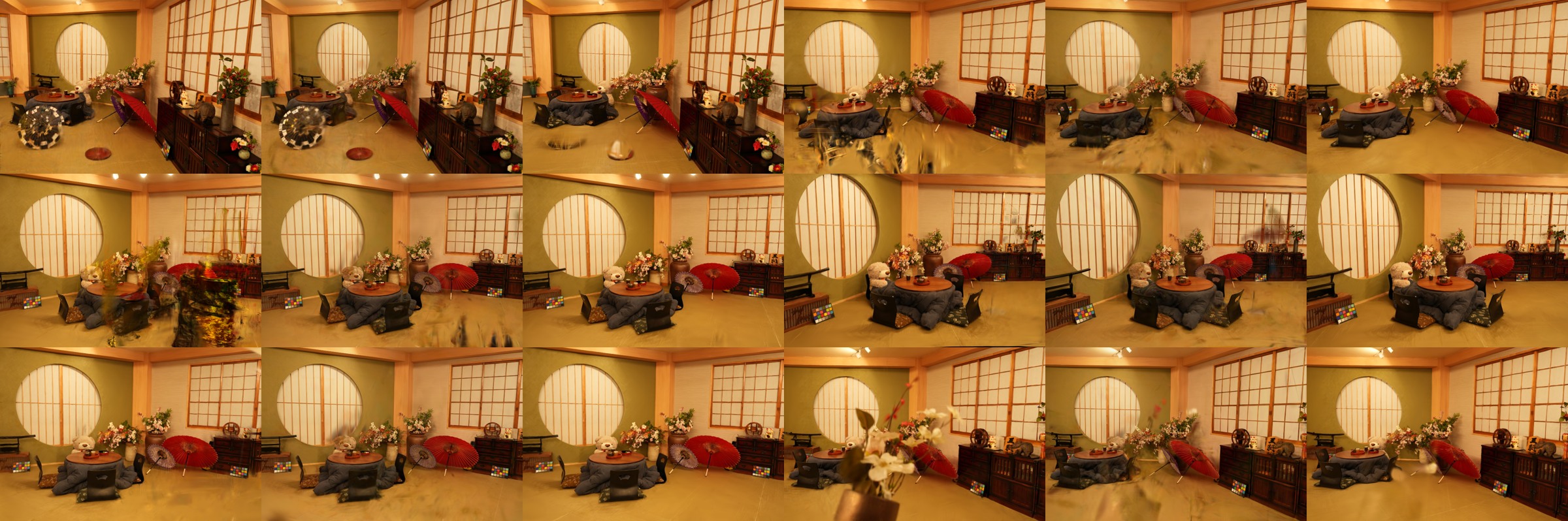
Left: Raw 3DGS · Centre: WildGaussians · Right: Agent-masked 3DGS. Pause and scrub to inspect floating transients, blurred geometry, and temporal stability.
Unified clean-test metrics
One shared Graphdeco evaluator and VGG-LPIPS implementation was used for all three methods.
| Method | PSNR ↑ | SSIM ↑ | LPIPS ↓ |
|---|---|---|---|
| Raw 3DGS | 22.295 | 0.780 | 0.293 |
| WildGaussians | 25.578 | 0.868 | 0.284 |
| Agent-masked 3DGS | 26.727 | 0.815 | 0.249 |
Result: agent masking improves raw 3DGS by 4.43 dB PSNR, +0.035 SSIM, and 0.044 LPIPS. Against WildGaussians it gains 1.15 dB and lowers LPIPS by 0.036; Wild retains the highest mean SSIM.
Synchronized individual videos
WildGaussians
Agent-masked 3DGS
Trajectory construction
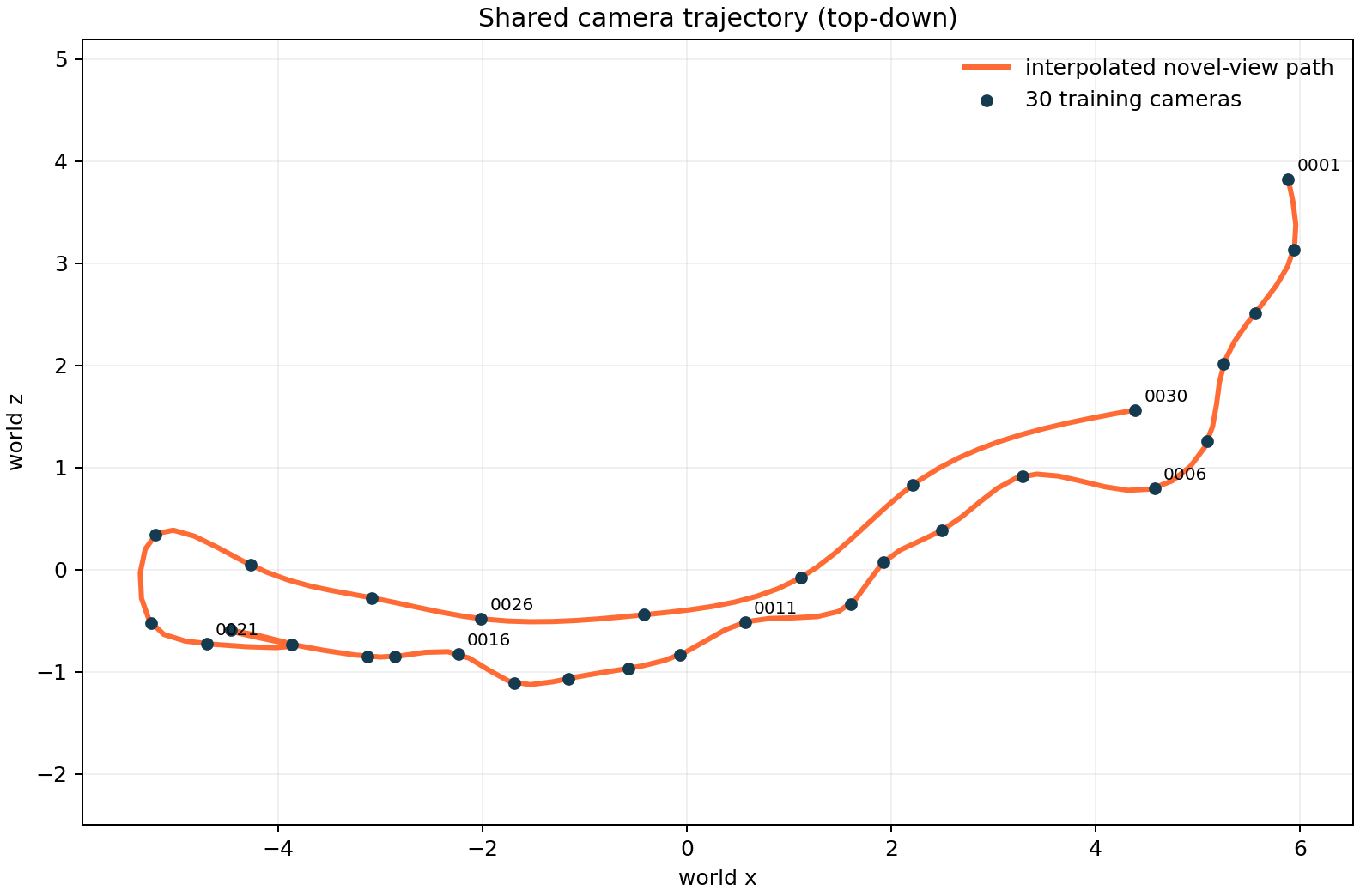
Natural cubic translation spline plus smooth SO(3) rotation spline through the ordered training cameras. The reverse traversal creates a continuous loop.
Six trajectory checkpoints
Interpretation
- The mask route produces a large, consistent improvement over raw 3DGS on clean held-out views, supporting the hypothesis that transient pixels were contaminating the static field.
- WildGaussians has the strongest SSIM, while the masked model has better PSNR and LPIPS. The video is therefore essential for distinguishing sharper static reconstruction from temporally stable but smoother rendering.
- This is still a Round-1 result: the masks were inferred from the Round-0 model. A second mask pass should focus only on residual boundary leakage rather than rediagnosing object semantics.