Contents |
Leap seconds
by Markus Kuhn
Leap seconds were introduced in 1972 to reconcile astronomical time, which is based on the rotation of the Earth, and physical time, which can be measured with amazing accuracy using atomic clocks.
Why do we have them?
Tidal friction within the Earth, caused by the gravitational pull of both the Moon and the Sun, continuously slows down the daily rotation of our planet. The modern-day definition of the unit of time, one second, approximates the length of the day divided by 60×60×24 as it was in 1820. Since then, the length of a day has increased by roughly 2.5 ms, following a long-term trend of the order of 1.7 ms per century. Superimposed on that trend are irregular fluctuations of a few milliseconds over decades, which since about 2000 have shrunk that excess almost to zero, and individual days have since 2020 even been slightly shorter again than 60×60×24 seconds.
With the invention of atomic clocks in the mid 1950s, a means of measuring time became available that is far more stable and accurate than the rotation of our planet about its own axis. This led to two alternative definitions of time:
- International Atomic Time (TAI), a time scale that was started in 1958 and has been defined without interruption by an international network of atomic clocks ever since;
- Universal Time 1 (UT1), an astronomical definition of time based on the position of the Sun in the sky, a modern and refined replacement for what used to be called Greenwich Mean Time.
TAI and UT1 were approximately equal at the introduction of TAI in 1958. But the rotation of the Earth fluctuates all the time and slows down in the long term, so UT1 has been falling behind ever since. As a result, TAI was in 2026 about 37 seconds ahead of UT1.
With two different definitions of time available, the question arose how exactly the civil time zones according to which we set our clocks should be defined. In 1970, a committee of the International Telecommunication Union (ITU), which is in charge of setting up international rules for the operation of radio time signals, agreed on a third definition of time, as a practical compromise, to be introduced on 1 January 1972:
- Coordinated Universal Time (UTC), a time scale defined such
that
- the difference between UTC and TAI is always an integral number of seconds;
- the difference between UTC and UT1 is never larger than 0.9 seconds (0.7 seconds until 1974).
UTC is a time scale defined by atomic clocks, just like TAI, but these atomic clocks are adjusted by inserting or deleting an additional leap second whenever UTC and UT1 are about to drift apart by more than 0.9 seconds. The ITU has put the responsibility of deciding when exactly to insert or delete a leap second into the hands of the IERS.
A time scale named UTC had already existed before that. The worldwide coordination of radio time signals started on 1 January 1960, and the name Coordinated Universal Time was adopted for the result in 1967. But until the end of 1971, that earlier UTC was kept close to astronomical time by slightly offsetting the frequency of the atomic clocks that generated it and by occasionally stepping it by a fraction of a second. Leap seconds replaced both of these mechanisms.
From 1972 on, UTC quickly replaced GMT as the international reference time for setting clocks, because it was easily available from time-signal radio stations. UTC had the advantage of being generated by atomic clocks, which are far cheaper and easier to operate than the precision telescopes used earlier, without changing the relationship to the traditional astronomical definition of time by more than a second, an amount negligible for all but a few specialist applications (such as pointing telescopes). Ever since, most civil time zones have been defined in relation to UTC, from which they typically differ by an integral number of hours (sometimes half or quarter hours). As a result, civil time zones have leap seconds simultaneously with UTC. If a leap second is announced, it is inserted as the 61st second (23:59:60 UTC) of the last “minute” of June or December.
Leap seconds were needed almost every year in the 1970s and 1980s, and on average every 1–2 years thereafter. However, due to an unusual temporary acceleration of the Earth, no leap second was needed during the 7-year gap between the end of 1998 and the end of 2005. That acceleration has continued: the most recent leap second so far was inserted at the end of 2016, and if the Earth keeps rotating as fast as it did in the 2020s, the first ever negative leap second may become necessary around 2029.
An in-depth introduction to leap seconds, especially in the context of the proposals to get rid of them, is
- Nelson, McCarthy, et al.: The leap second: its history and possible future, Metrologia, Vol. 38, pp. 509–529, 2001. (PDF made available here with permission, IoP original)
Efforts to abolish leap seconds
Starting with a UTC Questionnaire distributed by IERS in late 1999, several international scientific organizations (ITU, URSI, IAU, etc.) have initiated a consultation process on whether the definition of UTC should be modified. In particular, it has been proposed to remove leap seconds from the international reference time (UTC) that is broadcast in radio time signals, which is the basis of almost all regional civil time zones, thereby effectively decoupling civil timekeeping from the rotation of the Earth.
The main arguments in favour of abandoning leap seconds:
- leap seconds could cause disruptions where computers are tightly synchronized with UTC;
- leap seconds are a rare anomaly to deal with, which is a worry in particular with safety-critical real-time systems (e.g., new concepts for air-traffic control entirely based on satellite navigation);
- exact astronomical time plays no significant role in most people’s daily lives, and those who need to know UT1 exactly know already where to look it up.
The main arguments against abandoning leap seconds:
- there had been a lack of credible reports about serious problems caused by leap seconds (prior to 2012, see below);
- the assumption that UTC and UT1 differ by no more than a second is hardwired into a huge number of deployed systems (e.g., antennas that track satellites), which would cost a lot to modify;
- system designers who worry about leap seconds should simply use TAI instead of UTC, and all we need is easier access to TAI references;
- desktop computers and network servers could more easily cope with leap seconds if we had standardized guidelines on how to steer a computer’s clock around them;
- we must not give up the more than 5000-year-old human practice of defining time through Earth’s rotation because of unfounded worries of some air-traffic control engineers;
- abandoning leap seconds would break sundials.
Most of the discussion on this proposal since 2000 has taken place on the LEAPSECS mailing list (Steve Allen’s 2000–2006 archive, 2003-2006 [Javascript required] archive, 2007- [Javascript required] archive, broken old rom.usno.navy.mil link).
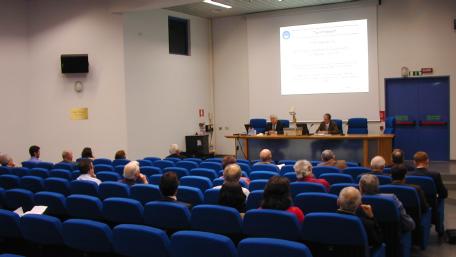
Torino meeting
A first meeting dedicated to the question of revising UTC and abandoning the leap second was the ITU-R SRG 7A Colloquium on the UTC timescale, which took place in Torino, Italy, 28–29 May 2003.
One of the proposals discussed there was to discontinue leap seconds in UTC in a few years time. At this point, the international reference time scale that is today UTC would be renamed into International Time (TI) and take over UTC’s role as the basis of local civil time zones.
Proceedings, presentation slides
There I gave a presentation
in which I discussed the history, current practice and available options of handling leap seconds in networked computer systems. I argued that
- Abandoning leap seconds in the international standard time would not cause any problems for computer systems that are not involved in controlling astronomical or aerospace systems, as long as national/regional civil time zones do the same.
- Not abandoning leap seconds would not cause significant problems for the vast majority of computers either. Most problems and concerns surrounding leap seconds and computers come merely from a lack of good standardized guidelines for how to handle them. An example of what such a guideline could look like is my UTC with Smoothed Leap Seconds proposal. It simply says that computer operating systems should slow down the speed of the clock that normally provides UTC to applications by 0.1% during the 1000 seconds before the end of any leap second inserted into UTC. Those computers that synchronize their internal clock tightly with UTC via a network time protocol usually already have facilities to calibrate the clock speed, so this is technically not very difficult to do.
- Much of the leap-second problem is caused by the primitive data formats used to disseminate time, especially those of various national LF time transmitters. They leave much to be desired and need to be upgraded to provide better information about leap seconds, atomic time and Earth-orientation parameters. Both TAI and UTC should be broadcast widely.
There are also some personal notes on the Torino meeting, which I posted to the LEAPSECS mailing list.
The US proposal
In September 2004, the United States delegation to ITU-R working party 7A submitted a proposed revision of the UTC standard (ITU-R TF.460), which aims to abandon leap seconds, for consideration by the ITU working party in November 2005. Daniel Gambis, head of the IERS Earth Orientation Center, used the occasion to suggest to all UTC users that this would be a good time to send their comments on this proposal to their respective national ITU representatives. See Steve Allen’s page for details.
This proposal
- maintains the name UTC;
- increases the allowed tolerance between UTC and UT1 from 0.9 seconds to 1 hour;
- asks the IERS to keep UTC from deviating by more than 1 hour from UT1 using leap hours instead of leap seconds;
- suggests that this change to the definition of UTC be implemented by December 2007.
In my opinion, this proposal is not acceptable for a number of reasons:
- UTC is widely used in computer applications specifically because it lacks the very disruptive leap hours that occur in many local time zones due to summer-time (US: daylight-saving time) arrangements. Introducing leap hours into UTC would eliminate one of UTC’s main advantages for such applications.
- A leap second is a fairly minor discontinuity, one that can be corrected comfortably in a computer system by a tiny change in the software-clock speed for a few minutes. A leap hour, on the other hand, is 3600 times more disruptive than a leap second! It is a very major discontinuity in what is meant to be a uniform time scale.
- A fairly regular, roughly annual event, such as a UTC leap second, is an expected routine matter that every person involved with precision timekeeping encounters and handles many times during their lifetime. On the other hand, an extraordinary event, such as a UTC leap hour, is a once-every-few-centuries matter that will hardly play any role in any system designs and will therefore hit those responsible for dealing with it largely unprepared.
- Introducing a leap hour into UTC will be perceived by computer operators as a potentially catastrophic hazard to the correct operation of millions of mission-critical computer systems. Our experience with the comparatively minor concern regarding the 2-digit year overflow from 1999 to 2000 (“Y2K bugs”) does not even begin to describe the range of concerns, problems and costs that a leap hour in UTC would create.
- Is it realistic to expect that the IERS or ITU-R – a small and obscure service office for astronomers and a United Nations radio-standards agency – will have the political power (or will even still exist) to cut an hour out of UTC when the first UTC leap hour is due in the 27th century? After all, this will likely be an unprecedented and extremely expensive and risky disruption, and UTC is the form of time that one uses exactly to avoid the annual summertime leaps of civil time. Back in 1582, the pope still had enough power to cut 10 days from the calendar, but even that took more than three centuries to be accepted everywhere. And that was before we had computers and liability!
I cannot believe that even the authors of this proposal seriously consider a UTC leap hour to be a realistic and practically implementable option. I can, therefore, only conclude that this proposed revision of UTC was meant as a fake package: an attempt to replace UTC forever with a leap-free atomic time, which pretends – in the interest of diplomatic convenience – to be nothing but a simple relaxation of the |UTC−UT1| tolerance.
While I do not believe that any modification to UTC is actually necessary, I could in principle live with a permanent switch from astronomical time to atomic time. However, any such proposal should
- be honest enough to actually say that its goal is to detach civil timekeeping entirely and forever from the rotation of Earth;
- no longer be called UTC;
- at least attempt to discuss how it expects future generations to handle the unbounded and ever faster increasing gap between TAI and UT1, which will eventually grow well above 1 day;
- be announced at least five years in advance, such that the many systems that depend on the current |UTC−UT1| < 0.9 s limit can be upgraded or taken out of service first, without unreasonable cost or inconvenience.
The 2004 US proposal failed on all of these points. It has not been implemented and further leap seconds have since been inserted in 2005, 2008, 2012, 2015 and 2016. However, the supporters of the UTC-leap-hour idea have not yet given up and in late 2008 claimed increasing support among ITU member countries. On the other hand, the UK, Canadian and Chinese governments appear to have gone on record by then with their opposition. The next vote on the issue was in January 2012 at the World Radiocommunication Conference 2012 and preceding Radiocommunication Assembly. The RA-12 Plenary of 19 January 2012 debate on the leap second decided to postpone the issue until the next Radiocommunication Assembly and World Radiocommunication Conference, scheduled for 2015. (To be continued ... see the What happened since section below.)
Related links
- Markus Kuhn’s Computer time resources
- Steve Allen is an astronomer and vocal opponent of the idea to decouple human timekeeping from the rotation of the Earth. He also maintains an excellent website on the revision of UTC.
- Rob Seaman also protests against allowing UTC to drift from UT1.
- The IERS plot of the difference UT1−UTC shows the one-second jumps caused by the leap seconds of 2005, 2008, 2012, 2015 and 2016, and how that difference has been growing again since about 2021, towards the +0.9 s that would call for a negative leap second.
Malfunctions related to leap seconds
Prior to 2012, there had been hardly any credible reports about real-world problems caused by leap seconds. This changed in 2012 when a leap second triggered a bug in the Linux kernel that appears to have been inserted in 2007 during an attempt to remove a presumed leap-second bug.
- 3 July 2007: Linux kernel commit 746976a3 (released in version 2.6.22) removed from the leap-second code path the call that informs the high-resolution timer subsystem of a change of the clock, because that call was made with interrupts disabled and could deadlock. It had hung all the servers of one site at the end of 30 June 2007 – a date at which no leap second was inserted, so the leap-second code must have been triggered by an erroneous announcement received via NTP. The commit anticipated as “only possible side effect” that a timer might fire “1 second too late, in the rare case of leap second deletion”, and that it would “never fire too early”.
- 1 July 2012: The leap second at the end of June 2012 caused the first widely reported computer failures. John Stultz diagnosed that, because of the notification removed in 2007, the high-resolution timers of the Linux kernel remained one second ahead of the system clock, so that absolute timers expired one second early and those set less than a second ahead returned immediately, which sent applications that wait in a loop – as is common with futexes – spinning at full CPU load. He noted that this had “likely potentially been around since” that 2007 commit. Among the systems affected were those of Reddit, Mozilla, Yelp and LinkedIn, as well as the Amadeus Altéa check-in system used by Qantas and Virgin Australia, whose staff had to check in passengers manually. Resetting the clock with date -s "`date`" worked around the problem.
- 11 July 2012: The kernel fix 4873fa07 added the missing notification back, now deferred to a software interrupt to avoid the 2007 deadlock, and 5baefd6d closed the remaining race window. Yet further leap-second bugs were still being fixed shortly before the 2015 leap second.
- 1 January 2017: The leap second at the end of 2016 caused a DNS failure at Cloudflare: its resolver software, written in Go, computed a negative time interval where its programmers had assumed that time never runs backwards, which then crashed the service. At the peak, about 0.2% of the DNS queries to Cloudflare were affected.
What happened since
- November 2015: The World Radiocommunication Conference (WRC-15) in Geneva decided that UTC retains the leap second for the time being. Resolution 655 (WRC-15) called for further studies of a continuous reference time scale, to be reported to the next conference in 2023.
- 27 October 2022: The ITU-R published the results of the studies requested by Resolution 655 (WRC-15) as Report ITU-R TF.2511-0, a 73-page survey of how UTC is used in radiocommunication services, time metrology, astronomy, geodesy, meteorology and industry, and of the impact that a change of UTC into a continuous time scale would have on each of them.
- November 2022: The 27th General Conference on Weights and Measures (CGPM) adopted Resolution 4 “On the use and future development of UTC”, which decided “that the maximum value for the difference (UT1−UTC) will be increased in, or before, 2035”, such that the continuity of UTC is ensured for at least a century, and asked the CIPM to propose that new maximum value and to draft a corresponding resolution for the 28th CGPM in 2026. With that, the decision moved from the ITU to the BIPM.
- December 2023: WRC-23 in Dubai endorsed the CGPM decision in Resolution 655 (Rev. WRC-23). It left the choice of the new maximum value and of the date when continuous UTC starts to the CGPM, to be prepared jointly with the ITU-R, and asked that the name “UTC” be kept. Until then, UTC remains defined by Recommendation ITU-R TF.460-6, that is with leap seconds. The ITU-R also stated that the new maximum value should be “no less than 100 seconds, taking into account the constraints of the technological systems expected to be used to disseminate this value”, and that implementing a new tolerance “will require a transitional period of up to 15 years […] the length of which shall take into account the planned lifetime of equipment and the implementation of backward compatibility for some categories of user”.
- Since 2016: No further leap second has been needed, because the rotation of the Earth has been accelerating since about 2015. At a workshop organized by the BIPM and IERS in March 2025, the world’s experts on Earth rotation agreed on a common model of its least-understood irregularities, which led to an estimated probability of about 30% that a negative leap second will become necessary within ten years, along with about 50% for another positive one (Report from the CCTF on Draft Resolution C, section 4). A negative leap second has never been applied, and both the BIPM and industry consider it a substantially larger risk to existing systems than a positive one.
- 31 August 2026: Elizabeth Gibney: The leap second is dead. Long live the leap hour? Nature news, summarizing the argument for abolishing leap seconds now rather than by 2035.
- 13–15 October 2026: The 28th CGPM, meeting in Versailles, votes on Draft Resolution C “On the technical actions needed to ensure the continuity of UTC”, which decides “that continuous UTC will become effective on 20 May 2027” and that “the maximum value for the difference |UT1−UTC| will be 3600 seconds (1 hour)”. A simple majority of the member states suffices. As no leap second can be scheduled before that date anyway, adoption would end leap seconds with immediate effect.
The maximum |UT1−UTC| difference of one hour now proposed is the same value as in the 2004 US proposal discussed above.
Media coverage
- Geoff Brumfiel: Astronomers leap to defence of extra seconds in time debate, Nature 423, 12 June 2003, p 671, doi:10.1038/423671a
- David Adam: What time is it? Well, no one knows for sure, Guardian, 26 June 2003.
- Andreas Hirstein: Der Schaltsekunde schlägt die Stunde. Neue Zürcher Zeitung, NZZ am Sonntag, 13 July 2003, pp 57-58.
- Jim Boulden: Time to skip leap seconds?, CNN.com, 22 July 2003.
- David Adam: The final countdown? The Age, Melbourne, 19 August 2003.
- Manfred Dworschak: Furcht vor dem Datenschluckauf. Der Spiegel, Nr. 35, 25 August 2003, pp 94-95.
- Adam Rogers: Why the World’s Clocks Are Wrong. Wired Magazine, Issue 11.11, November 2003.
- Stephen Battersby: Time warp. New Scientist, 22 November 2003. (letters)
- James Ryerson: Time Gap, The. New York Times Magazine, 14 December 2003.
- Roger Highfield: Hang on a second, what’s the real time? Daily Telegraph, 31 December 2003.
- Daniel Bächtold: Unser Kalender braucht mehr Zeit. Tagesanzeiger, 27 February 2004.
- Karen Wright: Leap Seconds. Discover Magazine, Vol. 25, No. 03, March 2004.
- Roxanne Khamsi: Leap second to be added to 2005. Nature News, 6 July 2005, doi:10.1038/news050704-8.
- Al Sicherman: Hey, got a minute? Or maybe just a second. Star Tribune, Minneapolis, 18 July 2005.
- Keith J. Winstein: Why the U.S. Wants To End the Link Between Time and Sun. The Wall Street Journal, 29 July 2005, page A1.
- Wendy M. Grossman: Time bandits. The Inquirer, 5 August 2005.
- Frank D. Roylance: Clock-syncing effort buys some time. The Baltimore Sun, 8 August 2005.
- Christian Speicher: Hat der Schaltsekunde die Stunde geschlagen? Neue Zürcher Zeitung, No. 232, p. 61, 5 October 2005.
- No more leap second? Heise Newsticker (English transl.), 9 November 2005.
- Leap second talks are postponed. BBC News, 9 November 2005.
- Devin Powell: Calls to scrap the 'leap second' grow. New Scientist, 17 December 2008.
- David Rooney: A place of pilgrimage at centre of the time system. Commentary, The Times, 17 December 2008.
- Mark Henderson: How a split second could spell end of GMT. The Times, 18 December 2008.
- Every second counts. Comment, Leading Article, The Times, 18 December 2008.
- Chris Irvine: Scientists propose 'leap hour' to fix time system. Telegraph.co.uk, 18 December 2008.
- Geht es der Schaltsekunde an den Kragen? Neue Zürcher Zeitung, 11 January 2012.
- Leap seconds – Their time has come. The Economist, 14 January 2012.
- World Radiocommunication Conference 2012 Newsroom: Status of Coordinated Universal Time (UTC) study in ITU-R
- Countries consider time out on the 'leap second'. The Examiner, 17 January 2012.
- Robert Gast: Die grauen Herren von Genf. Die Zeit, 26 January 2012.
Thanks to Steve Allen for providing various URLs.
created 2003-07-01 – last modified 2026-09-07 – https://www.cl.cam.ac.uk/~mgk25/time/leap/